Kitesurf light wind sessions: big kite, light wind board or foil?
There are 3 ways to get going when the wind is light: a bigger kite, a light wind board or a foil. Before you spend money on any of them, work on how you fly the kite, because that helps on every setup.
Light wind days teach you more about flying a kite than the days when it pulls you along on its own. To kitesurf light wind sessions, you need to keep the kite moving, feel the tension in your lines and get the board up to speed before it sinks. A light wind board helps you get going, but those skills still matter. They pay off at any spot where the wind comes and goes, and most of all on flat water, because chop slows a board down even more when there is little power.
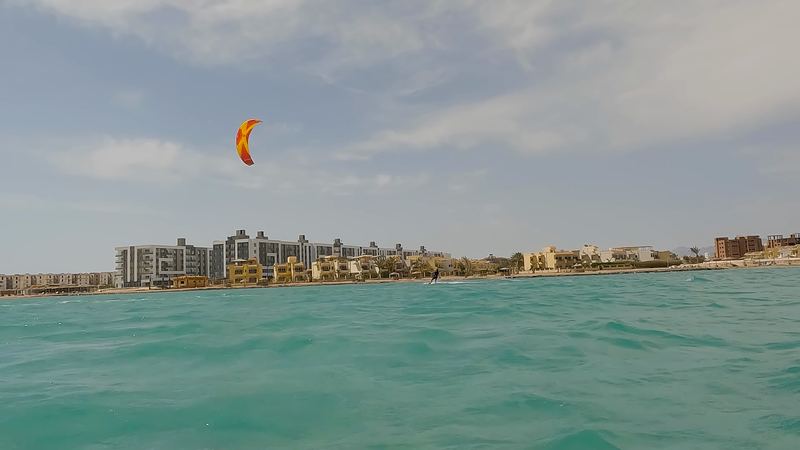
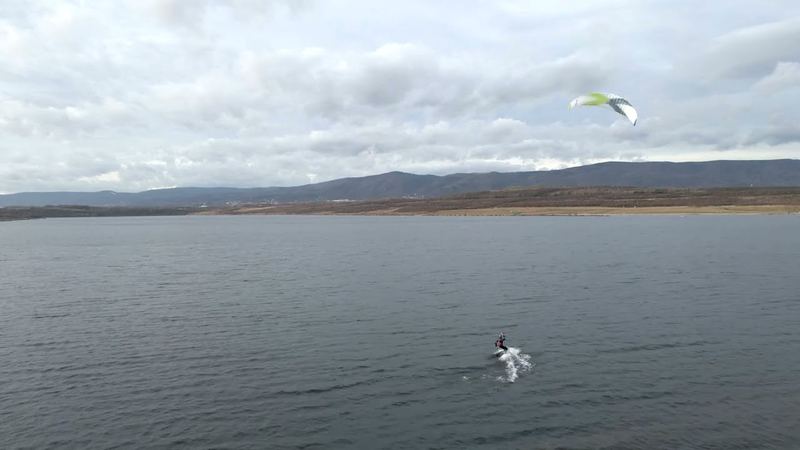
On New Year's Eve 2022 I was out on Lake Milada in the Czech Republic on a Kitech FreeRS 15 m², a foil kite, in low wind, and in April 2025 I had another light wind cruise. For days like these you have 3 options: a bigger kite, a light wind board or a foil. They differ in price and in how long they take to learn.
Which one makes sense depends on what is already in your garage.
How light is light wind
On a twin tip, light wind starts when you reach for the biggest kite in your bag. Airush's size chart for beginners and intermediates puts riders of 70-80 kg on 13-15 m² and riders of 80-90 kg on 14-17 m² in 10-13 knots (about 5-7 m/s). The chart stops at 10 knots, about 5 m/s, and below that your board, the type of kite and your technique matter more than any formula.
For a starting size based on your weight, use the kite size calculator.
Big kite, light wind board or foil: comparison
| Big kite | Light wind board | Foil | |
|---|---|---|---|
| What you buy | a kite of roughly 12-17 m² depending on your weight | a wide board with low rocker, typically 150-160 cm | a foil and a foil board |
| What you get | more pull with the board you already ride | planes earlier, so a smaller kite will do | less drag than a twin tip once the board lifts; confident foilers may use a smaller kite |
| Watch out for | a big kite turns more slowly | you still need your normal board for stronger wind | takes time to learn, needs enough depth for the mast |
| Makes sense when | you ride a twin tip and want to get out now | you already own a big kite | you want to ride mostly in light wind in the future |
Big kite: inflatable or foil kite
A big inflatable is the simplest route, because it handles like the kite you already know. When choosing one, look closely at how it relaunches in light wind.
A foil kite has no tubes. The Kitech FreeRS fills with air through intakes in the leading edge, and Kitech builds it for water, foiling, snow, land and buggies. According to Windy.app, a foil kite gets airborne in lighter wind than an inflatable. Both inflatable and foil kites get heavier when wet and may not relaunch in light wind. Water can also enter a foil kite's cells. The Kitech's rib system channels that water to outlets at the wing tips; it does not dry the wet canopy.
With a big kite, 2 tweaks that Damien LeRoy shows are worth trying. A bigger bar gives you more leverage and turns a big kite faster. Line extensions of 3 or 5 m (according to him most lines are 20-24 m, and you can go up to 30 m) give the kite a longer power stroke when you dive it. Everything happens a little slower, so you have more time to react.
Light wind board
If you already own a big kite, the board is what I would look at next. A board that planes early can let you ride a slightly smaller kite in the same wind. Light wind boards tend to be wider and have low rocker, meaning they are only slightly curved from tip to tip. Cabrinha's Stylus, for example, is built purely for light wind and comes in 150 and 160 cm.
Damien LeRoy suggests using different boards for light and stronger wind. A light wind kiteboard complements your normal twin tip, which stays in the quiver for windier days.
Foil
Once the foil lifts the board clear of the water, it has less drag than a twin tip. Windance suggests a kite 1-3 m² smaller than for a twin tip as a rough guide for confident foilers. While learning, you may need a larger kite than an experienced foiler in the same conditions. The size still depends on your foil, skills and the wind.
When starting kite foiling, allow time to learn and choose a spot deep enough for the mast to clear the bottom. If you want to make use of a light wind day with your existing twin tip skills, I would look at a bigger board or kite first.
Technique: what to do with the kite and the board
Whatever you ride, in light wind it comes down to whether the kite is flying or just hanging there. You can work on your bar and board technique on your next session without buying anything.
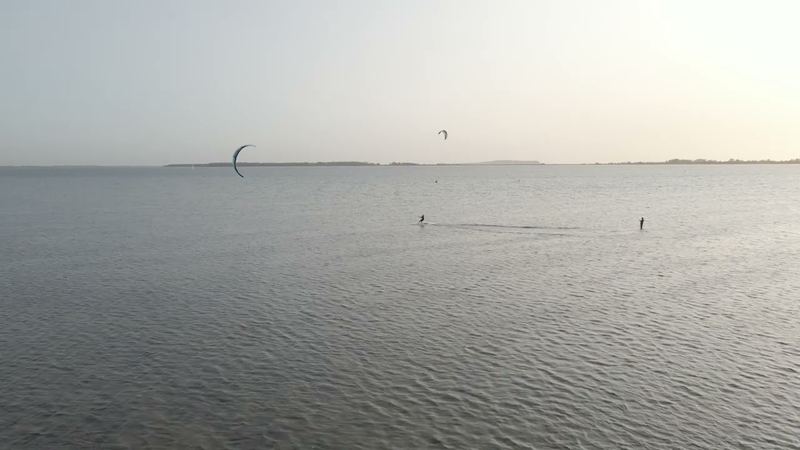
Bar out, not in. When there is little pull, the instinct is to pull the bar in. That shortens the steering lines, so the kite brakes, slows down and can end up backstalling, sliding backwards out of the sky. Ease the bar out a little and steer to keep the kite flying fast. Damien LeRoy adds a point about trim: if your kite backs up as soon as you pull in, rig the steering lines on the most depowered knot, even when there is hardly any wind. The trim knots are the knots on the kite's pigtails where you attach the steering lines, and they set how much the kite pulls.
Speed first, then edge. A slow board sits deep in the water and drags. After your waterstart, point the board slightly downwind, build speed and only then edge across the wind and a little upwind. Don't keep heading downwind, because you catch up with the kite and the lines go slack. Shifting a bit of weight onto your front foot also helps, so the tail doesn't sink.
Feel your line tension. As long as you feel tension in the front lines, the kite is lifting. When it fades, steer to keep the kite moving. Slow, steady movement can help maintain line tension and keep the kite airborne; if the wind drops too far, even that will not be enough.
Fly the kite higher. There is less wind close to the water, and a kite parked low pulls you more sideways than it lifts. Higher up it has more lift and room to dive and pick up tension again.
Learn the downloop before relying on it. If a kite loses power at the edge of the window in light wind, a downloop can help it regain speed and climb again. Practise with an instructor in the water, in an area chosen for the spot's conditions, with clear space downwind and to either side. A kite can pull you off your feet even in light wind. Damien LeRoy demonstrates this technique for light wind only; do not apply it in strong wind.
Launching. Walk a bit further upwind with the kite and angle it further downwind until you feel tension in the lines. In the Kitesurf College tutorial, a kite launches this way in 3 knots, about 1.5 m/s.
Apparent wind is the wind the kite feels as you and the kite move through the air. Walking or riding upwind adds to it, walking downwind takes it away. That is why a kite holds better in light wind when you step upwind with it, and drops when you back off downwind towards it.
When to stay on the beach
Light wind can die completely, and then you swim. Damien LeRoy admits in his video that he has swum in about 100 million times this way, so you will be in good company. These are the rules I stick to:
- Stay close to shore. Kitesurf College recommends it while you practise the techniques from the video.
- If the wind blows from the shore out to sea, don't go out in light wind. Once it drops, it carries you away from the beach and you won't get back.
- Self rescue is an essential kitesurfing safety skill. Learn it before you need it.
- A wet kite may not take off again in light wind. Expect to pack it down in the water now and then.
Light wind and a kite safari
On the kite safari in Egypt that I go on, nobody waits for the wind in one place. On days 2-6 the boat moves between islands according to the wind, with 2 sessions scheduled each day, morning and afternoon. Evening video coaching is also on the programme for days 3-6. Paradise Kitesurf describes Tawila as a lagoon with steady wind of 15-25 knots (about 8-13 m/s), shallow water and a sandy bottom. If light wind days at home have taught you to handle the kite, you can use your time on flat water to practise jumps and transitions, turning without stopping, because the kite no longer keeps you busy.
Questions
What kite should I use for light wind kitesurfing?
A big one. Airush's size chart puts riders of 70-80 kg on 13-15 m² and riders of 80-90 kg on 14-17 m² in 10-13 knots (about 5-7 m/s). According to Windy.app, a foil kite gets airborne in lighter wind than an inflatable.
Is a foil or a bigger kite better for light wind?
Once the foil lifts the board clear of the water, it has less drag than a twin tip, so a confident foiler can use a smaller kite. Foiling takes time to learn. A big kite or a light wind board builds on the twin tip skills you already have.
How long should my lines be for light wind?
Damien LeRoy says most brands ship lines of 20-24 m and recommends 3 or 5 m extensions for light wind, up to 30 m in total. The kite gets a longer power stroke and everything happens a bit slower.
Why does my kite keep falling out of the sky in light wind?
There are several possible causes: pulling the bar in too far can stall the kite, while a drop in wind can reduce lift and leave the front lines slack. Low over the water, the kite also has less wind and less room to manoeuvre. Ease the bar out if you are oversheeting; smooth steering and flying the kite higher can help maintain line tension.
Sources
- Airush size chart for beginner and intermediate twin tip riders: 60-70 kg in 10-13 knots (5-7 m/s) 12-14 m², 70-80 kg in 10-13 knots (5-7 m/s) 13-15 m², 80-90 kg in 10-13 knots (5-7 m/s) 14-17 m²; the chart starts at 10 knots (5 m/s); boards with good early planing allow a slightly smaller kite in light wind airush.com (checked 18 October 2026)
- 1 knot = 0.5144 m/s (10 knots is about 5.1 m/s) www.nist.gov (checked 17 October 2026)
- Kitech FRS v2: kite filled with air through leading edge intakes; the rib system channels water from inside the cells to wing tip outlets; for kitesurf, kitefoil, snowkite, landboard and kitebuggy wp.kitechkites.com (checked 18 October 2026)
- A foil kite can be lifted into the air in lighter wind than an inflatable kite windy.app (checked 17 October 2026)
- Cabrinha Stylus 2026: designed purely for light wind, wide outline and low rocker for early planing and upwind performance, sizes 150 x 45 cm and 160 x 47.5 cm www.cabrinha.com (checked 18 October 2026)
- A foil reduces drag once the board is flying; Windance suggests 1-3 m² smaller than a twin tip as a rule of thumb for confident foilers, depending on foil and skill; learners may need a larger kite than experienced foilers in the same conditions; a larger board planes earlier and may allow a smaller kite www.windance.com (checked 18 October 2026)
- Damien LeRoy (video, from 0:36): a bigger bar gives more leverage and turns a big kite faster; line extensions of 3 or 5 m, most lines 20-24 m, up to 30 m, longer power stroke; big board, ideally a high wind and a light wind board; a foil rides in the same conditions as a twin tip with more power, takes time to learn; if the kite backs up when you pull in, rig the most depowered knot even in the lightest wind; save a dropping kite with a downloop, light wind only; has swum in about 100 million times in light wind, know how to self rescue www.youtube.com (checked 17 October 2026)
- Kitesurf College (video): oversheeting can cause backstall, demonstration in 6-7 knots (about 3-3.6 m/s); aim the board slightly downwind for speed, then edge crosswind and slightly upwind; weight on the front foot; a wet kite gets heavier; a drop in wind can reduce lift and front line tension, smooth movement may help; less wind close to the surface, fly the kite higher; a downloop may save a dropping kite; launch: walk upwind, angle the kite further downwind, demonstration in 3 knots (about 1.5 m/s); practise near shore in water because the kite can knock you over www.youtube.com (checked 18 October 2026)
- Video from Jája's channel: Milada, 31 December 2022, Kitech FRS 15 m in low wind www.youtube.com (checked 17 October 2026)
- Paradise kite safari: days 2-6 include morning and afternoon sessions, moving between islands according to the wind; evening ride analysis (video coaching) is scheduled on days 3-6; Tawila steady wind 15-25 knots (about 8-13 m/s), shallow water, sandy bottom paradisekitesurf.cz (checked 18 October 2026)
- Duotone Neo safety guidance: fly over unobstructed water, keep space downwind and to either side clear; risk of uncontrolled lofting a.storyblok.com (checked 18 October 2026)
- IKO teaches downloops in its Freeride course for advanced riders; instruction depends on skill, weather and spot conditions www.ikointl.com (checked 18 October 2026)
- Apparent wind combines true wind with wind induced by the movement of the rider and kite d8.ikointl.com (checked 18 October 2026)