Kiteboard size guide: how long and wide your twintip should be
Twintip size comes down to your weight, your level and the wind you ride in most. The size charts from Duotone and North show how much the weight ranges overlap and how to choose within them.
Level: Beginner
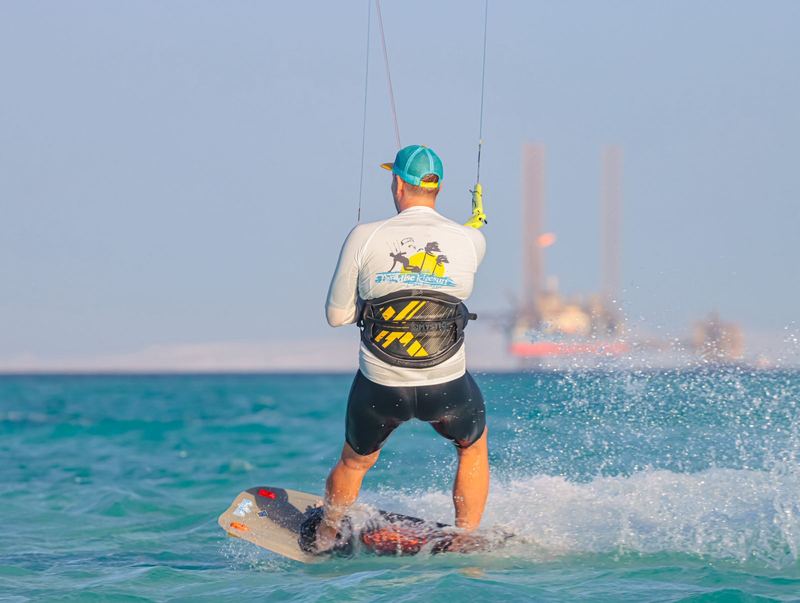
Just finished a kite course and choosing your first board? The kiteboard size guide answer is short: find your weight in the size chart of the board you like and, within your weight range, lean towards the larger size. At about 70 kg, for example, both the Duotone Gonzales and the North Prime have a 138 cm board in your range. A larger board starts gliding on the water sooner and is easier to ride upwind, which means angling into the wind so you can get back to your starting point instead of drifting down the beach. Upwind riding is usually the next skill to learn after a course.
Most manufacturers publish a kiteboard size chart that matches board length and width to a rider weight range. Your level and the wind you ride in most then decide whether you take the size in the middle of your range or a size up or down.
The ranges are wide and they overlap. On the North Prime 2026, a rider of 75-79 kg fits 3 sizes, and North notes under its chart that the recommendation is subject to ability level, wave height and wind speed.
These charts are for twintips. A twintip has the same shape at both ends, so it rides in both directions and you do not have to swap your feet when you turn. It is the board most people learn on and use for freeride, which means relaxed all-round riding, including your first jumps. Surfboards and foil boards are sized differently.
Length and width: what each one does
A twintip has 2 numbers, for example 138 x 41. The first is the length in centimetres, the second the width at the widest point.
- Length gives you lift and glide. A longer board planes earlier (it rises and glides on top of the water instead of pushing through it), carries you through lulls when the wind drops for a moment, and makes riding upwind easier.
- Width adds surface area. A wider board gets going in less wind and makes waterstarts easier, the moment when the kite pulls you out of the water and up onto the board. Duotone describes its Spike light-wind board as having a large surface area underfoot for easy water starts.
- A smaller board is quicker to put on edge (tilting the board onto its side, which is how you hold your line against the pull of the kite), easier to control in strong wind and livelier for tricks. Slingshot sums it up on its Glide V14 page: larger boards plane earlier and feel more stable in lighter wind, smaller boards feel quicker and more playful.
In the Duotone and North size charts, width grows together with length. In practice you pick a size and the width comes with it.
Kiteboard size charts by rider weight
These are the official charts as published on 16 October 2026. Each board has its own chart, so always check the one for the model you are buying.
Duotone Gonzales 2026 (entry-level freeride)
| Size (cm) | Rider weight |
|---|---|
| 130 x 38 | 50-65 kg |
| 134 x 40 | 60-75 kg |
| 138 x 41.5 | 70-85 kg |
| 142 x 43 | over 75 kg |
| 151 x 44 | over 75 kg |
North Prime 2026 (freeride)
| Size (cm) | Rider weight |
|---|---|
| 136 x 40 | under 80 kg |
| 138 x 41 | 65-90 kg |
| 141 x 42 | 75-100 kg |
| 144 x 43 | 85-110 kg |
| 148 x 44 | 90-120 kg |
| 152 x 45 | 95-125 kg |
Duotone Jaime SLS 2027 (for tricks and big jumps, not a first board)
| Size (cm) | Rider weight |
|---|---|
| 133 x 40 | 50-75 kg |
| 136 x 41 | 70-85 kg |
| 139 x 42 | 80-95 kg |
| 142 x 43 | over 85 kg |
Side by side, a rider of about 70 kg lands on 133-138 cm, a rider of about 85 kg on 136-151 cm, and riders over 100 kg on 142 cm and up. The 85 kg range is wide because the 2 largest Gonzales sizes only have a lower limit (over 75 kg). The Jaime, Duotone's performance board for tricks (freestyle) and high jumps (big air), runs slightly smaller for the same weight than the 2 freeride boards, which matches Duotone's advice that freestyle riders prefer a compact board.
When to go bigger
Take the larger size from your range, or the next one up, in these cases.
You are a beginner. Within your weight range, lean towards the larger size. Duotone's general rule of thumb for beginners and light-wind riders is a board of around 140-145 cm, because it planes earlier and makes upwind riding easier. Where a chart only gives a lower limit (the 2 largest Gonzales sizes say over 75 kg), the largest size is not automatically the right one. Getting upwind is the skill that keeps you from walking back along the beach, and a bigger board makes it easier. My guide to beginner kitesurfing gear covers the rest of the set-up.
Your home spot has light wind. If most of your sessions are on the edge of being rideable, extra length and width keep you on the water longer. For the lightest days there are dedicated light-wind twintips:
| Light-wind board | Size (cm) | Rider weight |
|---|---|---|
| Duotone Spike Concept Blue 2026 | 153 x 46.5 | over 40 kg |
| Duotone Spike Concept Blue 2026 | 164 x 47.5 | over 40 kg |
| North Trace 2025 | 145 x 45 | under 80 kg |
| North Trace 2025 | 155 x 46 | 80-120 kg |
| Slingshot Glide V14 | 161 cm long | not listed |
North recommends the Trace with its 13, 15, 17 and 19 m Reach kites, so it is a board for big kites in light wind.
When to go smaller
Right after a course you will rarely need a smaller board. A smaller size from your range starts to make sense later, once you ride confidently and:
- You ride mostly in strong wind. Duotone recommends intermediate to advanced riders go slightly smaller, around 132-138 cm, for more control and agility, especially in stronger winds.
- You want to jump and do tricks. Duotone's advice for freestyle riders is a compact board for faster edge control and higher pop, the spring that lifts you off the water when you jump.
- You are already confident upwind. Once riding upwind is automatic, you do not need the extra float of a larger board and a smaller one feels more direct.
If you sit right on the border between 2 sizes and cannot decide, go larger. Duotone's own advice is to start a bit larger for stability and downsize as your skills grow.
How board size and kite size work together
Board size and kite size affect each other. A bigger board planes in less wind, so it lets you get going on the same kite in lighter conditions, or on a slightly smaller kite in the same wind. A small board in light wind needs a bigger kite to get you going.
This matters most on the edges of the wind range: in light wind the board counts as much as the kite. To work out the kite side of the equation, read what size kite you need or put your weight and wind speed into the kite size calculator. Kiters usually give wind speed in knots: 1 knot is 1 nautical mile per hour, which is 1.852 km/h.
Surfboards and foil boards are a different category
The charts and advice for twintips do not apply to directional boards. Directional boards ride efficiently in one direction only, and Duotone notes they are used for wave riding or foilboarding.
- Kite surfboards are sized in feet and inches, like surfboards. North, for example, sells its Cross kite surfboard in 5ft 1in, 5ft 3in and 5ft 5in.
- Foil boards are for hydrofoiling, on a board with a wing on a mast under it that lifts it above the water. They have their own size charts. North's kite foil boards, such as the Scoop, come in 120 x 46 and 135 x 49 cm.
The weight tables for twintips do not carry over to these boards. If you are moving to waves or foiling, use the chart for that specific board.
Board size on a kite safari
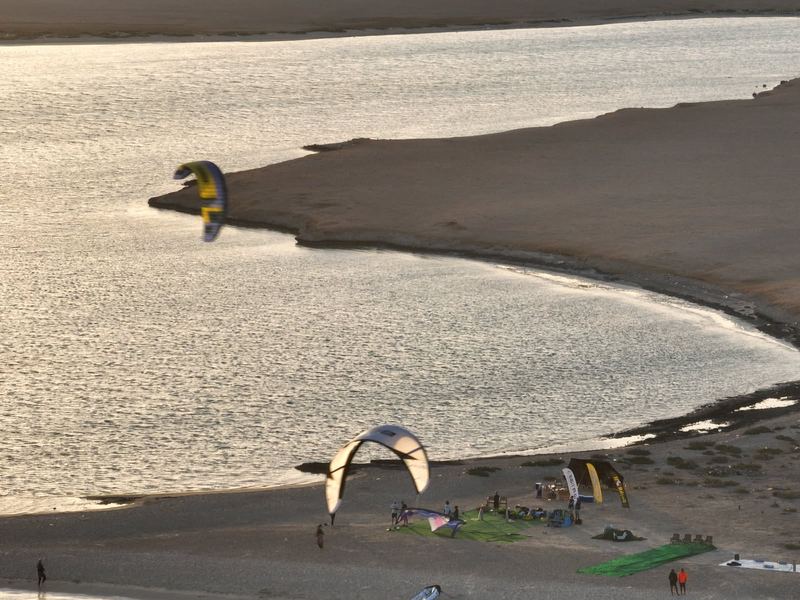
On a kite safari in Egypt you ride at islands and their lagoons. Paradise Kitesurf describes its spots as shallow, with steady wind and few riders, though some islands also have deeper water or waves. According to guests, the spots mostly have offshore wind, which blows from the island out to sea. If you fall and cannot get back, the wind carries you away from land, which is why a rescue boat watches the water. Your usual size from the chart works there, and as a beginner you lean towards the larger size in your range.
If you can't ride on your own yet, start with a course on the coast. The safari gives the most to riders who already ride on their own after a course. There is also a 6-day beginner course on board (€600 with gear); Mohamed confirms how many instructors come along with your dates.
A twintip in a board bag adds weight and cost to every flight. On the Paradise Kitesurf safari you can rent a twintip for €60 for 6 days, so you can fly with just your kites, bar (the handle you steer with) and harness (the belt that hooks you to the bar). What else to take is in my kite safari packing list.
Questions
What size kiteboard do I need for my weight?
Use the size chart of the board you are looking at. On the North Prime 2026, for example, a rider of 65-90 kg fits the 138 x 41 cm and a rider of 75-100 kg the 141 x 42 cm. The ranges overlap, so your level and the usual wind decide between 2 sizes.
Should a beginner get a bigger kiteboard?
Yes, within your weight range, lean towards the larger size. Duotone's general rule of thumb for beginners and light-wind riders is around 140-145 cm, because a larger board planes earlier and makes riding upwind easier. Where a chart only gives a lower limit, such as the 2 largest Duotone Gonzales sizes (over 75 kg), the largest size is not automatically the right one.
What size twintip is best for light wind?
Light-wind twintips are usually wider and longer than standard boards for the same rider weight. The Duotone Spike Concept Blue 2026 comes in 153 x 46.5 and 164 x 47.5 cm, and the North Trace 2025 in 145 x 45 cm (under 80 kg) and 155 x 46 cm (80-120 kg).
Is board width as important as length?
Width and length come together. In the Duotone and North charts the width grows with the length, from 38 cm on the smallest board to 47.5 cm on the largest light-wind board. A wider board has more surface area, so it planes earlier and makes waterstarts easier.
Sources
- Duotone twintip rule of thumb: size depends mainly on weight, riding level and wind; beginners or light-wind riders choose a larger board around 140-145 cm (planes earlier, easier upwind); intermediate to advanced riders slightly smaller 132-138 cm, especially in stronger winds; freestyle riders a compact board; start larger and downsize as skills grow; a twintip rides in both directions so you don't have to switch your feet when changing course and is ideal for freeride, freestyle and learning; directional boards are used for wave riding or foilboarding and ride efficiently one way www.duotonesports.com (checked 16 October 2026)
- Duotone Gonzales 2026, entry-level freeride board: 130/38 for 50-65 kg, 134/40 for 60-75 kg, 138/41.5 for 70-85 kg, 142/43 for over 75 kg, 151/44 for over 75 kg www.duotonesports.com (checked 16 October 2026)
- Duotone Jaime SLS 2027: 133/40 for 50-75 kg, 136/41 for 70-85 kg, 139/42 for 80-95 kg, 142/43 for over 85 kg www.duotonesports.com (checked 16 October 2026)
- Duotone Spike Concept Blue 2026, light wind board: 153/46.5 and 164/47.5, both for riders over 40 kg; large surface area underfoot for easy water starts www.duotonesports.com (checked 16 October 2026)
- North Prime 2026 freeride size chart: 136 x 40 cm under 80 kg, 138 x 41 cm 65-90 kg, 141 x 42 cm 75-100 kg, 144 x 43 cm 85-110 kg, 148 x 44 cm 90-120 kg, 152 x 45 cm 95-125 kg; rider size recommendation is subject to ability level, wave height and wind speed northactionsports.com (checked 16 October 2026)
- North Trace (freeride lightwind, 2025): 145 x 45 cm under 80 kg, 155 x 46 cm 80-120 kg; large surface area for early planing in the lightest winds; ideal for use with the 13/15/17/19 m Reach northactionsports.com (checked 16 October 2026)
- Slingshot Glide V14 is a light-wind and progression twin tip, board size 161; larger boards plane earlier and feel more stable in lighter wind, smaller boards feel quicker and more playful; choose size by rider weight, wind strength and riding style slingshotsports.com (checked 16 October 2026)
- North sizes its kite surfboards in feet and inches (Cross Surfboard 5ft 1in, 5ft 3in, 5ft 5in) northactionsports.com (checked 16 October 2026)
- North Scoop kite foil board (tagged Kite): sizes 120 x 46 cm and 135 x 49 cm northactionsports.com (checked 16 October 2026)
- 1 knot = 1 nautical mile per hour; 1 nautical mile = 1852 m (so 1 knot = 1.852 km/h) www.bipm.org (checked 16 October 2026)
- Kite safari spots offer shallow water, steady winds and few riders; Geisum: combination of shallow and deeper water; Ashrafi: mix of calm water and waves; guest review (Jan Procházka): the spots are mostly with offshore winds; rescue boat included; beginner course €600 (6-day intensive course including kite equipment); twintip rental €60 / 6 days paradisekitesurf.cz (checked 16 October 2026)