Learn to kitesurf: hours, course steps and IKO levels
Most people need 6-12 hours of kitesurfing lessons, according to IKO. The spot, the wind and the school decide a lot of it.
Level: Before the first lesson
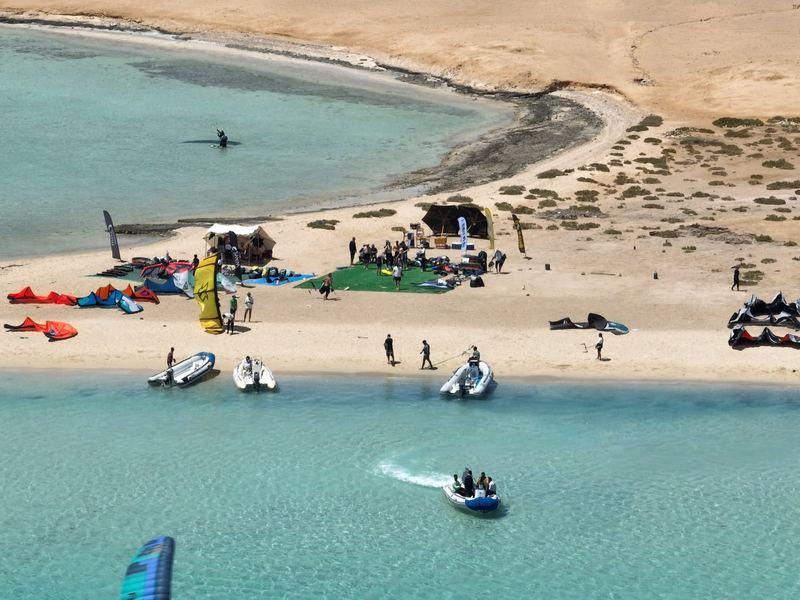
Learning to kitesurf takes most people 6-12 hours of lessons, says the International Kiteboarding Organization (IKO): often more than 12 and rarely less than 6. IKO's own blog says not to expect it in 1 day and not to let failed first attempts discourage you. An IKO course starts on land with safety, so before you go into the water you already know how to release the kite's pull.
Beginners progress fastest with 3 things on their side: steady wind, shallow flat water and an instructor who can talk to them while they are out on the water.
How long does it take to learn kitesurfing?
Most beginners need 6-12 hours of lessons. Schools often teach in blocks of 2-3 hours. At the Paradise kite centre, for example, the 8-hour course takes 2-3 days and the 12-hour course 4 days.
IKO also publishes an average number of hours for each of its first 3 levels:
| IKO level | What you learn | Average hours (IKO) |
|---|---|---|
| Level 1 Discovery | checking the spot (the place where you kite), kite setup, safety systems such as the quick release (it frees you from the kite's pull), flying the kite on land, launching and landing | 2 |
| Level 2 Intermediate | entering the water with the kite, body dragging (letting the kite pull you through the water without the board), relaunching the kite from water, self-rescue (getting yourself and the kite back to shore when you can't ride), getting back to your board, first waterstarts (getting up on the board from the water) | 4 |
| Level 3 Independent | controlling speed by edging (pressing the board's edge into the water), riding upwind (against the wind, so you don't drift away), changing direction, riding toeside (with your back to the kite), launching the kite on your own | 8 |
Added up, IKO's averages for Levels 1-3 come to 14 hours before you ride on your own.
What makes it faster or slower
IKO names 3 things that change the number of hours: what you already know, the weather during your course and the spot itself (flat, shallow or wavy water). IKO also advises against long breaks between lessons, though a good instructor will quickly bring you back up to speed.
What a beginner kitesurfing course looks like
On land: flying the kite
You start on the beach. The instructor explains the wind window (the area of sky where the kite can fly) and the safety systems, how to set up the kite, launch and land it, and how to let go of the bar (the control bar you hold and steer with) when something goes wrong. Steering the kite left and right while pushing and pulling the bar takes coordination, and you stay on land until your kite control is reliable.
In the water: body dragging
Next you go into the water without a board and let the kite pull you. This is body dragging. You learn to drag in different directions, relaunch the kite from the water and get back to a board you have lost. You will use it a lot: after a failed waterstart attempt, body dragging is how you get back to your board.
The waterstart
Getting up on the board means steering the kite, balancing on the board and holding your body position all at once. IKO says the waterstart usually takes extra time for exactly this reason. Expect plenty of attempts.
Riding and staying upwind
The last part of a beginner course is about riding: controlling speed with the edge of the board, turning and above all riding upwind. Until you can, you drift downwind (in the direction the wind blows) and walk back up the beach. In IKO's description, this is the part of the course where you become an independent kiteboarder.
IKO levels and the IKO certificate
IKO has 5 kiteboarder levels: Discovery (Level 1), Intermediate (Level 2), Independent (Level 3), Advanced (Level 4) and Evolution (Level 5). A beginner's path covers Levels 1-3.
Level 3 is the one that matters for beginners. IKO says that as an independent rider you can ride on your own and rent equipment wherever you go. Your level is recorded in your IKO profile, which works as a digital kite passport that other IKO centres and instructors can check, so the next school does not have to start from zero.
2 practical requirements: IKO lists swimming as the entry condition for the first course, and IKO sets the minimum age at 12; younger children can learn only with an instructor who has completed IKO's course on teaching children.
Why a shallow lagoon and steady wind speed up learning
Steady wind and shallow, flat water save you hours. IKO's own advice for learning faster is a spot with steady wind of about 15-20 knots (roughly 28-37 km/h), without crowds, without shallow reefs and without hazards on land.
In waist-deep water on a sandy bottom you can stand up whenever you fall, walk back to your board and reset. The instructor can stand next to you. On flat water the board does not get pushed around by waves, so the waterstart is the only thing you are fighting. Steady wind means the kite behaves the same way on every attempt.
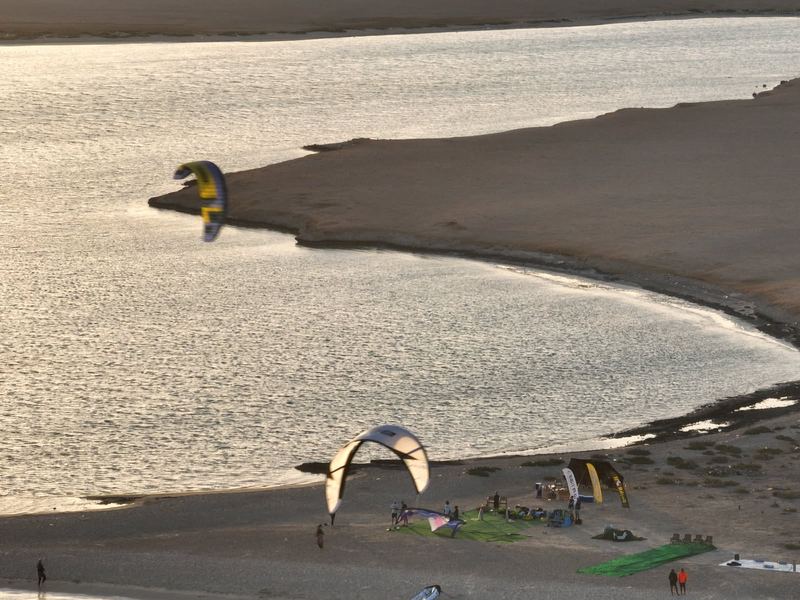
Mohamed's school near Hurghada offers this in 2 settings. The Paradise kite centre sits on a wide, shallow, warm lagoon (water separated from the open sea) with a sandy bottom, and the wind blows onshore at a slight angle, meaning towards the beach, so a beginner drifts back to land. On the safari, the crew picks the spot according to the wind, typically Geisum, Abu Minqar or Ashrafi. Abu Minqar (Abu Mungar on the Paradise website) is a smaller island with a lagoon and calm shallow water over sand. On the island spots the wind blows mostly offshore, from the island out to sea; guest Jan Procházka mentions it in his review on the Paradise website. That is why a rescue boat watches the water and picks up anyone who cannot get back. More about the individual spots is in my guide to the Red Sea kite safari islands, and about the season in when to kitesurf in Egypt.
Kite lessons over radio
Once you start riding, you are quickly out of earshot of an instructor on the beach. With a radio on you, the instructor can correct you during the run: bring the kite lower, edge harder, look where you are going. The Paradise kite centre teaches all its courses via walkie-talkies. When you compare schools, ask whether radio is standard or an extra, and whether it is used for the whole course.
Learning on a kite safari vs in a kite centre
Both are run by Mohamed's Paradise Kitesurf. The difference is the setting and how the course is put together.
| Kite safari (2026 price list) | Paradise kite centre (website price list, October 2026) | |
|---|---|---|
| Beginner course | €600, 6-day intensive course including kite gear | 8 h €440, 12 h €600, 15 h €690 (private); €360 / €480 / €540 per person when 2 students share an instructor |
| IKO certificate | not included, requires at least 8 hours with an instructor | IKO certificate after the course |
| Where you learn | island lagoons, the boat moves to a spot that suits the wind | 1 lagoon in El Khayam between Hurghada and El Gouna |
| Support | beach boys (crew on the beach who carry and pump up your gear) help with launching and landing, rescue boat; students per instructor not published, Mohamed confirms how many instructors come along with your dates | max. 2 students per instructor, lessons via walkie-talkies, rescue boat on standby |
| Other courses | refresh course 3 h €180, 6 h €330; individual lessons €65/h | individual lessons; refresh course for advanced riders (jumps, tricks, wave riding) |
The safari itself costs €1,250 per person in a twin cabin for 8 days and 7 nights, and the beginner course is an add-on. Courses start on day 2, after the first move to a spot.
If you can't ride on your own yet, start with a course on the coast. The safari gives the most to riders who already ride on their own after a course. There is also a 6-day beginner course on board (€600 with gear); Mohamed confirms how many instructors come along with your dates. The IKO certificate is not part of that course and needs at least 8 hours with an instructor, and nobody can promise you will ride on your own after a week, because IKO's averages up to Level 3 add up to 14 hours. If the IKO certificate and a fixed number of hours matter more to you, a course in the centre has both in the price. I wrote more about the centre in kitesurfing in Hurghada and El Gouna, and everything about the boat, upcoming dates and the enquiry form is on the kite safari in Egypt page.
How to choose a kitesurfing school
- Certified instructor. IKO lets you look up instructors and centres worldwide; VDWS, the German water sports schools association, has its own school and instructor search. Ask for the instructor's name and check it.
- Students per instructor. Ask how many students share 1 instructor and 1 kite. The Paradise centre caps it at 2.
- Spot. Shallow water with a sandy bottom, steady wind, enough space and no reef in the learning area.
- Rescue. Ask whether a boat is ready while you are on the water. Beginners drift downwind, and someone has to bring them back.
- Gear in the price. Kite, board, harness (the belt with a hook that takes the kite's pull off your arms), helmet and life jacket should be part of the course price. Buying your own gear can wait until after the course; my guide to kitesurfing gear for beginners covers what to look at then.
- Radio. Standard or extra, for the whole course or only some sessions.
- Certificate. Is the IKO (or another) certificate included, and how many hours do you need for it?
- Language. Learning is much easier in a language you think in. The Paradise centre teaches in English, German, Czech and Arabic.
- What happens without wind. Ask how lost hours are handled when the wind drops.
Questions
How long does it take to learn kitesurfing?
IKO says learning to kitesurf usually takes 6-12 hours of lessons, often more than 12 and rarely less than 6. IKO's average hours for Levels 1-3 add up to 14 hours before you are an independent rider.
Do I need to be able to swim to learn kitesurfing?
Yes. IKO lists swimming as the entry requirement for its first course (Discovery, Level 1). IKO sets the minimum age at 12; younger children can learn only with an instructor who has completed IKO's course on teaching children.
What does IKO Level 3 mean?
Level 3 is Independent Kiteboarder. You can control your speed, ride upwind, change direction and launch on your own, and IKO says you can then ride on your own and rent equipment wherever you go.
Can a complete beginner join a kite safari in Egypt?
There is a 6-day beginner course on board (€600 with gear), and Mohamed confirms how many instructors come along with your dates. If you can't ride on your own yet, start with a course on the coast; the safari gives the most to riders who already ride on their own after a course. IKO certification is not included in the €600 and requires at least 8 hours with an instructor.
How much does a beginner kitesurfing course cost near Hurghada?
At the Paradise kite centre in El Khayam, a beginner course costs €440 for 8 hours, €600 for 12 hours and €690 for 15 hours with a private instructor. Sharing the instructor with another student costs €360, €480 and €540 per person (website price list, October 2026).
Sources
- Learning to kitesurf usually takes 6-12 hours of lessons, often more than 12 and rarely less than 6; schools often teach in 2-3 hour blocks; course goes from land skills to body dragging, waterstart and riding upwind; best not to take long breaks between lessons, a good instructor quickly brings you back up to speed; do not expect to be done in 1 day; sometimes first attempts do not go as planned d8.ikointl.com (checked 16 October 2026)
- IKO tip for faster learning: steady wind of about 15-20 knots; avoid crowded spots, shallow areas with underwater reefs and land hazards d8.ikointl.com (checked 16 October 2026)
- IKO has 5 kiteboarder levels: Discovery (1), Intermediate (2), Independent (3), Advanced (4), Evolution (5) d8.ikointl.com (checked 16 October 2026)
- IKO Level 1 Discovery: land skills, safety systems, piloting, launch and land; average 2 hours; minimum age 12, younger children only with an instructor who completed IKO's Teaching to Children course; swimming required; hours depend on knowledge, weather and spot (flat, shallow, waves) d8.ikointl.com (checked 16 October 2026)
- IKO Level 2 Intermediate: body drag, water relaunch, self-rescue, board recovery, waterstart; average 4 hours d8.ikointl.com (checked 16 October 2026)
- IKO Level 3 Independent: speed control, riding upwind, transitions, toeside, self-launch; average 8 hours; you can ride on your own and rent equipment wherever you go d8.ikointl.com (checked 16 October 2026)
- IKO certification is recorded in your IKO profile, which works as a digital kite passport for instructors and centres; IKO lets you find instructors and centres worldwide d8.ikointl.com (checked 16 October 2026)
- VDWS offers school and instructor search (Schule finden, Instructor finden) www.vdws.de (checked 16 October 2026)
- Paradise kite centre beginner courses: 8 h (2-3 days) €440 / €360, 12 h (4 days) €600 / €480, 15 h (5 days) €690 / €540; max. 2 students per instructor; kite, board, harness, helmet and life jacket included; lessons via walkie-talkies; IKO certificate after the course; English, German, Czech, Arabic paradisekitesurf.cz (checked 16 October 2026)
- Paradise kite centre: wide shallow warm lagoon with sandy bottom, wind onshore at a slight angle, rescue boat on standby, station in El Khayam between Hurghada and El Gouna paradisekitesurf.cz (checked 16 October 2026)
- Kite safari 2026: 8 days / 7 nights, €1,250 per person; beginner course €600 (6-day intensive incl. kite gear), refresh course 3 h €180 / 6 h €330, individual lessons €65/h; beach boys help with launching and landing; rescue boat; courses start on day 2; shallow lagoons; the crew picks spots according to the wind (e.g. Geisum, Ashrafi); Abu Mungar (Abu Minqar): smaller island with a lagoon, shallow calm water, sand paradisekitesurf.cz (checked 16 October 2026)
- Guest review on the Paradise safari page (Jan Procházka): the spots are mostly with offshore winds paradisekitesurf.cz (checked 16 October 2026)
- Kite safari: IKO certification requires min. 8 hours with an instructor and is not included in the price (organiser's 2026 offer, kite safari WhatsApp group) paradisekitesurf.cz (checked 16 October 2026)