What size kite do I need? Weight, wind, board and level
Your weight in kg divided by the wind in knots, times 2.2, gives a first estimate of your kite size. Your board, level, gusts and foiling then move that number.
Level: Beginner
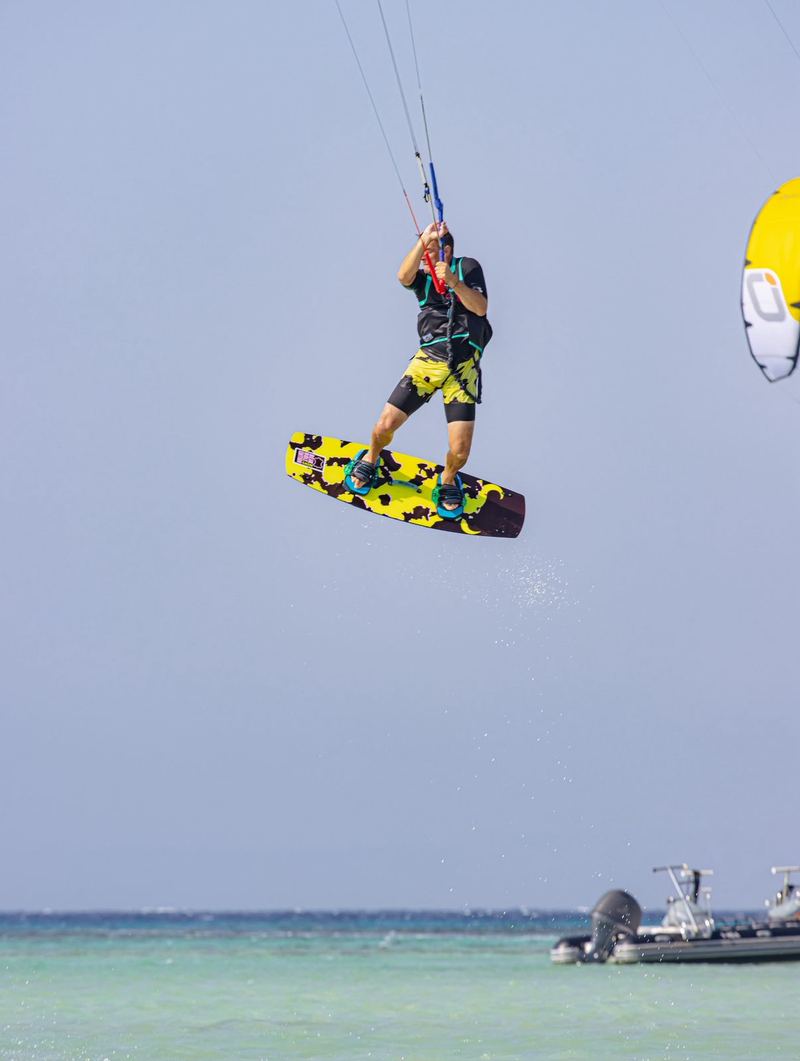
What size kite do I need? If you have just finished a course and are choosing your first kite, the Kitesurf Centre suggests 1 kite between 9 and 12 m², sized for the wind you will ride most. For your own number, use a simple rule: your weight in kilograms divided by the wind in knots, times 2.2. Wind speed in kiting is measured in knots; 1 knot is 1.852 km/h.
Kite size depends on your weight, the wind, your level, your board and the kite model, so the answer is always a range. Feeling unsure about it after a course is normal. When in doubt, start with the smaller kite: Peter's Kiteboarding and Airush both give this advice.
I fly an Ozone Catalyst 16 m² and Kitech FreeRS kites in 12 and 15 m², and each of them suits different wind.
The quick rule: weight / wind x 2.2
The formula is kite size (m²) = weight (kg) / wind (knots) x 2.2.
- 75 kg rider, 15 knots: 75 / 15 x 2.2 = 11 m²
- 75 kg rider, 25 knots: 75 / 25 x 2.2 = 6.6 m²
- 58 kg rider, 16 knots: 7.9 m², so an 8 m² kite (the example used in the Peter's Kiteboarding handbook)
The same rule circulates on kite forums. On the Australian forum Seabreeze, several riders ran their own numbers through it and found it close. 2 riders of 65 kg disagreed. One gets just the right pull from a 10 m² kite in 20 knots, where the rule gives about 7 m². The other had too little pull (was underpowered) on an 11 m² in 15 knots, where the rule gives 9.5 m², and wondered whether it works better for heavier riders. Treat it as a rule of thumb and adjust it to your own experience.
One school, The Kitesurf Centre in the UK, uses the same structure with a different multiplier for each level. It teaches weight / wind x ability, with 1.8 for beginners, 2.1 for intermediates and 2.3 for independent riders. They say openly that their equation tends to give a smaller kite than needed, which suits learning.
The kite size calculator on this site uses 2.2 for a standard twin tip (the symmetrical board you can ride in both directions) and adjusts the result for your board and for your level: beginner, independent or advanced.
Kite size chart by weight and wind
These values come straight from the 2.2 rule for a twin tip. Wind speeds in brackets are converted from knots (1 knot = 1.852 km/h).
| Rider weight | 12 kn (22 km/h) | 15 kn (28 km/h) | 18 kn (33 km/h) | 22 kn (41 km/h) | 26 kn (48 km/h) |
|---|---|---|---|---|---|
| 50 kg | 9.2 m² | 7.3 m² | 6.1 m² | 5.0 m² | 4.2 m² |
| 60 kg | 11.0 m² | 8.8 m² | 7.3 m² | 6.0 m² | 5.1 m² |
| 70 kg | 12.8 m² | 10.3 m² | 8.6 m² | 7.0 m² | 5.9 m² |
| 80 kg | 14.7 m² | 11.7 m² | 9.8 m² | 8.0 m² | 6.8 m² |
| 90 kg | 16.5 m² | 13.2 m² | 11.0 m² | 9.0 m² | 7.6 m² |
| 100 kg | 18.3 m² | 14.7 m² | 12.2 m² | 10.0 m² | 8.5 m² |
In practice you round to the nearest size you can actually buy or rent. The calculator does the same and always stays between 5 and 18 m².
How does this compare with manufacturers? For 80-90 kg, Airush lists 14-17 m² at 10-13 knots, 10-11 m² at 18-22 knots and 8-9 m² at 23-28 knots. Around 12-13 knots the rule lands in the same range, at 10 knots it comes out bigger, and from 18 knots up it comes out up to about 2-3 m² smaller. If you are between the rule and the Airush chart on a gusty day, take the smaller kite.
Duotone gives these sizes for a beginner's first kite:
- up to 65 kg: 7-9 m² (wind 18-28 knots)
- 65-80 kg: 9-11 m² (16-25 knots)
- 80-95 kg: 11-13 m² (14-22 knots)
What changes the number
Your weight
Heavier riders need more pull. Manufacturer wind ranges assume an average rider: Ozone states 80 kg for the Catalyst, and windy.app notes that most brands work with about 75 kg. A common adjustment is 1 m² of kite for every 10 kg above or below that average.
Wind and gusts
Pull grows quickly with wind speed, which is why the same rider can go from a 12 m² to a 9 m² kite in an afternoon. When the wind is gusty (it comes in short bursts of stronger wind), Windance advises basing your choice on the upper side of the wind range, and Reedin Baltics goes further: size for the strongest gusts you expect, not the average. If your forecast shows m/s: 10 knots is about 5.1 m/s.
Your level
Beginners do better with a smaller kite. A kite that is slightly underpowered is easier to control, and you can still learn to ride. Airush's advice from their riders: if you are unsure between 2 sizes, take the smaller one. The calculator on this site reflects this by giving beginners a kite about 10% smaller, my own setting for that advice; the independent and advanced levels keep the result as it is. For a 75 kg rider in 18 knots that means 8 m² instead of 9 m² after rounding to the nearest common size. On a hydrofoil the calculator does not apply this reduction.
Your board
- Twin tip: the default, coefficient 2.2 in the calculator.
- Big twin tip or light-wind board: a bigger board planes earlier (starts gliding on top of the water in less wind), so you can fly a smaller kite. The calculator uses a coefficient of 1.9 here, my own setting based on that earlier planing.
- Surfboard (directional, a board with a nose and a tail, ridden in one direction): Reedin Baltics notes that riders in waves prefer a slightly smaller, faster-turning kite. The calculator subtracts 1 m² from the twin tip result, my own setting for that "slightly smaller".
- Hydrofoil (a board with a wing on a mast under it that lifts it above the water): the foil creates little drag once it lifts, so foilers fly much smaller kites. The calculator takes the twin tip result and subtracts 2 m².
How to pick the board itself is covered in my kiteboard size guide.
The kite model
2 kites with the same number on the wingtip can pull differently. Peter's Kiteboarding reminds riders that power and depower range (how much pull you can let off by pushing the bar away) vary between brands and models, and that the manufacturer's wind range in the manual is the reference. For example, Ozone's chart for the current Catalyst V5 in 16 m² covers about 10-16 knots for intermediate riders and 8-18 knots for advanced ones (80 kg rider), with the sweet spot (where it works best) around 12-14 knots.
Why kiters own 2-3 kites
1 kite covers only part of the conditions you will ride in. Most riders end up with 2 or 3 kites: windy.app considers 2 or 3 the optimal number, and the Kitesurf Centre says most riders find 3 enough.
Typical spacing:
- Peter's Kiteboarding: a strong-wind kite about 3 m² smaller than your main kite (for example 11 and 8 m²)
- Reedin Baltics: steps of 2-3 m², such as 7, 9 and 12 m²
- Bigger gaps leave holes in your wind range, smaller ones overlap
The Kitesurf Centre suggests starting with 1 kite between 9 and 12 m², chosen for the wind you ride most, and adding sizes as you start going out on lighter or windier days.
Among the kites I fly are the Ozone Catalyst 16 m² and the Kitech FreeRS in 12 and 15 m², all from the bigger end of the size range. On Lake Milada in Czechia I have ridden the 15 m² in low wind.
Kite size matters on a kite safari in Egypt too. Paradise Kitesurf describes Tawila, its most popular spot (visited only by prior arrangement, as entry is paid), as a huge lagoon (shallow water partly enclosed by land) with a sandy bottom and steady 15-25 knots. For a 75 kg rider the rule gives 11 m² at 15 knots and about 7 m² at 25 knots. That is wider than 1 step of 2-3 m² covers, so in practice 2-3 sizes help. You do not have to buy them before the trip: complete kite equipment can be rented for €300 for 6 days. According to a guest review on the Paradise website, the safari spots mostly have offshore wind, which blows from the island out to sea; that is why a rescue boat stays on the water and picks up anyone who cannot get back. If you can't ride on your own yet, start with a course on the coast. The safari gives the most to riders who already ride on their own after a course. There is also a 6-day beginner course on board (€600 with gear); Mohamed confirms how many instructors come along with your dates. What a week on board looks like is in what to expect on a kite safari.
When the rule does not work
Very light and very strong wind
The calculator warns you below 10 knots and above 25 knots. In very light wind the result depends more on board, kite model and technique than on the formula. In strong wind the margin for error shrinks: Peter's Kiteboarding recommends not riding above 25 knots until you have logged at least 30 sessions, and not going out above 40 knots at all.
Gusty, shifting wind
The formula assumes steady wind. Gusts make a big kite feel much stronger in bursts. On such days take the smaller kite.
Hydrofoil
Foiling is where the 2.2 rule fails most clearly. Duotone, for example, does not give a foil coefficient: its size finder asks for the board type (twin tip, directional or foil) instead. Shops describe it as a difference from the twin tip: Windance says 1-3 m² smaller once you are comfortable on the foil, Reedin Baltics says 2-3 m². Windance also adds that early foil learners may stay slightly bigger until their take-offs feel consistent.
The calculator on this site follows the shops: it takes the twin tip result and subtracts 2 m², which falls within both ranges. For 80 kg in 15 knots that means 10 m² against 12 m² on a twin tip. The beginner setting does not reduce the foil size, so a beginner gets the same kite as an experienced rider. While you are learning to take off, follow Windance and go a size up.
Kite type
Charts like Windance's assume an inflatable kite (one with air-filled tubes). Windy.app notes that a foil kite (a parafoil without inflatable tubes) can fly in lighter wind than an inflatable one, so treat the formula as a rough guide for foil kites.
Lessons
If you are taking lessons, the instructor chooses the kite for each session based on the wind and your level. What to expect from the first lessons is in how to learn kitesurfing.
Questions
What size kite do I need for my weight?
A common rule of thumb is weight in kg divided by wind in knots, times 2.2. A 75 kg rider in 15 knots gets 11 m², in 25 knots 6.6 m². Treat it as a starting point and check the wind range your kite's manufacturer gives.
What is the best first kite size?
Duotone recommends 7-9 m² for beginners up to 65 kg, 9-11 m² for 65-80 kg and 11-13 m² for 80-95 kg. The Kitesurf Centre suggests a first kite between 9 and 12 m², sized for the wind you will ride most.
How many kites do I need?
Most riders end up with 2 or 3 kites. Peter's Kiteboarding suggests a strong-wind kite about 3 m² smaller than your main one, and Reedin Baltics describes quivers spaced 2-3 m² apart, such as 7, 9 and 12 m².
Do you need a smaller kite for foiling?
Yes, once you are comfortable on the foil. Shops give 1-3 m² (Windance) or 2-3 m² (Reedin Baltics) smaller than a twin tip in the same wind. While you are still learning to take off, a slightly bigger kite helps.
Does the 2.2 kite size formula work in gusty wind?
Only partly. Gusts make a big kite feel much stronger, so size for the stronger end of the wind range rather than the average, and pick the smaller kite when you are between 2 sizes.
Sources
- Rule of thumb: weight (kg) / wind (knots) x 2.2 = kite size in m²; example 58 kg / 16 knots x 2.2 = 7.9, use an 8 m kite kitesurfing-handbook.peterskiteboarding.com (checked 16 October 2026)
- If in doubt, use a smaller kite rather than a larger kite; secondary strong-wind kite typically 3 m² smaller than the main kite; kite power varies between brands and models; a smaller board needs more wind to plane; do not ride above 25 knots before 30 sessions, nor above 40 knots kitesurfing-handbook.peterskiteboarding.com (checked 16 October 2026)
- Same 2.2 rule posted on the Seabreeze kitesurfing forum (5 Nov 2011); riders reported it fits well; one 65 kg rider rides a 10 m in 20 knots where the rule gives 7 m, another 65 kg rider was underpowered on an 11 m in 15 knots where it gives 9.5 m and asked whether it works better for heavier riders; another noted board size and type strongly influence kite size www.seabreeze.com.au (checked 16 October 2026)
- Kitesurf Centre instructors' equation: rider weight / wind speed x ability (1.8 beginner, 2.1 intermediate, 2.3 independent rider); it generally gives a smaller kite than needed, ideal for learning; +/- 1 m per 10 kg from an 80 kg average; most riders find 3 kites enough; first kite usually 9-12 m www.thekitesurfcentre.com (checked 16 October 2026)
- Duotone beginner kite sizes: up to 65 kg 7-9 m² (18-28 knots), 65-80 kg 9-11 m² (16-25 knots), 80-95 kg 11-13 m² (14-22 knots); the lighter you are or the stronger the wind, the smaller the kite; the size finder on the same page asks for board type (twintip, directional, foil) www.duotonesports.com (checked 16 October 2026)
- Ozone Catalyst V5 wind range is indicative only, based on an average rider weight of 80 kg, and varies with skill level and board; 16 m chart: intermediate to advanced band about 10-16 knots, advanced band about 8-18 knots, sweet spot around 12-14 knots; 12 m advanced about 10-22 knots, sweet spot 14-18 knots ozonekites.com (checked 16 October 2026)
- Airush chart for beginner to intermediate riders on twin tips: 80-90 kg 14-17 m² in 10-13 knots, 12-13 m² in 14-17 knots, 10-11 m² in 18-22 knots, 8-9 m² in 23-28 knots; boards that plane early allow a slightly smaller kite; if unsure, choose the smaller kite airush.com (checked 16 October 2026)
- Foil riders typically size 1-3 m smaller than the twin tip chart once comfortable; early foil learners may choose slightly bigger; in gusty wind base the choice on the upper side of the wind range; two 10 m kites can feel different www.windance.com (checked 16 October 2026)
- Hydrofoilers fly kites 2-3 m² smaller than twin tip riders in the same conditions; bigger twin tips plane earlier; wave riders prefer slightly smaller, faster-turning kites; size for the strongest expected gusts; quivers spaced 2-3 m² apart (7, 9, 12 m) reedinbaltics.com (checked 16 October 2026)
- Optimal number of kites is 2 or 3; manufacturer wind ranges usually assume a rider of about 75 kg, +/- 1 m² per 10 kg; beginners better at the lower end of the range; a foil kite can be flown in lighter wind than an inflatable windy.app (checked 16 October 2026)
- 1 knot = 0.5144444 m/s (1.852 km/h) www.nist.gov (checked 16 October 2026)
- Tawila island on the Paradise Kitesurf safari: most popular spot, by appointment only because of the entrance fee, huge lagoon, steady winds 15-25 knots, shallow water, sandy bottom; rescue boat included; crew ensures safety and rescue on the water; guest review (Jan Prochazka): the spots are mostly with offshore winds; optional: rental of complete kitesurf equipment €300 / 6 days, beginner course €600 / 6-day intensive course including kite equipment paradisekitesurf.cz (checked 16 October 2026)