Kitesurfing equipment: the complete buying guide
Kitesurfing equipment has 4 main parts: kite, bar and lines, board and harness; you'll also need a safety leash and protective gear. I'd start with what has to fit your body and finish with what has to fit your spot.
Kitesurfing equipment has 4 main parts: a kite, a bar with lines, a board and a harness. You'll also need a kite safety leash with its own release and an accessible line cutter. For an inflatable kite, add a pump, clothing for the conditions and, for your first independent sessions, I'd recommend a watersports helmet and a certified buoyancy aid compatible with your harness. I wouldn't buy all of it the week after your course, though. A few weeks of riding will tell you a lot more about the board and kite size you actually need.
A harness and a wetsuit are chosen for your body and work with rental gear too, so they come first. The kite and bar are the biggest spend, and the right size depends on where and in what wind you'll ride most, so buy them last.
If you're still nervous about launching and landing on your own, owning a kite won't fix that. A few days on rental gear with someone on the beach to help you launch and land, or a short refresher lesson, will.
What a kitesurf setup includes and when to buy each piece
| Item | What it does | When to buy it |
|---|---|---|
| Harness | Takes the kite's pull on your hips, so your hands only steer | First |
| Wetsuit or rash vest | Warmth, sun and scrape protection | With the harness, for your local water |
| Kite safety leash with release | Connects the safety line to your harness | With your own setup; keep a line cutter accessible in the harness |
| Watersports helmet and buoyancy aid | Head protection and certified buoyancy; an impact vest cushions impacts | Before your first independent sessions |
| Board (twin tip) | What you stand on | Once you can waterstart (get up from the water) and ride both ways |
| Kite with bar and lines | The kite generates pull; the bar steers it and adjusts power | Once you know where you'll ride most |
| Pump | Inflates an inflatable kite | With the kite; check what's included and the valve adapter |
| Another kite size | Covers lighter or stronger wind | When you repeatedly lack the right size for safe riding |
1. Harness: the first thing that should be yours
The harness has a hook that the loop on your bar clips into. Your hips then carry the kite's pull and your hands just steer. Buying your own lets you choose a fit that works for your body and use it with rental kites too. Try it under load: it shouldn't ride up under your ribs or dig in. Keep a line cutter accessible in the harness.
You'll choose between a waist harness and a seat harness. A seat harness has leg straps that hold it lower and stop it riding up. A waist harness gives you more freedom to move. Try different shapes and sizes under load; what matters is how they fit you.
2. Wetsuit, helmet and buoyancy aid
Buy a wetsuit for the water you'll ride in most often. Use Vissla's temperature guide as a starting point:
- 5/4 mm for 7-10 °C (45-51 °F) water, with sealed seams, boots and gloves; plan for a hood in the cold too
- 4/3 mm for 11-14 °C (52-58 °F), with sealed seams and boots or gloves as needed
- 3/2 mm for 15-18 °C (59-65 °F)
- 2 mm spring suit from 19 °C (66 °F)
Factor in air temperature, wind, time in the water and how easily you get cold. If in doubt, I'd choose the warmer option. I'd only use a rash vest for sun protection in conditions where you don't need a wetsuit's warmth.
For your first independent sessions, I'd get a well-fitting watersports helmet and a certified buoyancy aid designed to work with a harness. An impact vest cushions knocks but doesn't, by itself, guarantee the buoyancy you need. IKO recommends at least 50 N for students; check the specific vest's rating and try it with your harness. Local rules and your equipment manual also determine what you must wear.
3. Board: go bigger with your first twin tip
A twin tip is a symmetrical board you ride in both directions without turning it around. I'd choose it as a first board for straightforward changes of direction and learning the basics. I'd leave surfboards and hydrofoils until you're riding confidently.
Within the range suitable for your weight and conditions, I'd go a little bigger. More surface helps you get planing earlier and ride upwind, back toward where the wind comes from. A board that's too small for your weight and conditions makes both harder; width and shape matter as well as length. Follow the specific model's size chart and try it if you can. Buying used makes sense if you find a suitable board in good condition at a good price. Whether you replace it later depends on how your riding develops.
Check whether the board comes with pads and straps (the bindings) and fins. New boards are sometimes sold without bindings.
4. Kite and bar: the biggest spend comes last
Which type of kite
For a first kite on water, I'd recommend an inflatable freeride model. Its inflated structure keeps it afloat and allows a water relaunch. Foil kites fill with wind: open-cell designs are for land, while closed-cell models designed for water can also relaunch from it. When choosing a kite, look for a versatile freeride or all-round model and check with an instructor that you can handle it and reduce its power.
It pays to buy a brand you see a lot at your local spot. Service, spare parts and advice from other riders are easier to get. And when it's time to upgrade, the kite sells faster.
What size
Kite size depends mainly on your weight and the wind you'll ride most. Buy your first kite for the wind that blows most often at your home spot, not for the strongest day you've seen. The kite size calculator gives you a quick estimate.
Bar, lines and quick release
The bar steers the kite, and the lines connect it to the kite. Activating the quick release should let a correctly functioning safety system shed most of the pull; some pull can remain. The safety leash connects the safety line to your harness and has its own release for complete separation. This is the kite leash, not a board leash. When buying, check the specific release system's certification to ISO 21853:2020.
Buy a bar explicitly approved by the manufacturer for your kite's model and generation. Matching brands don't guarantee compatibility. Before buying used gear, I'd have a specialist check the whole setup, including free movement along the safety line and the bar travel required by the manual.
Before every session, open and reset both the bar and leash releases on dry land as instructed by the manufacturer, and inspect your bar and lines. Practise emergency procedures with an instructor, including when to use each release.
A second kite
I'd add another size when you repeatedly lack a suitable kite for conditions you can safely handle. That depends on the wind and your ability, rather than the end of a season. If the wind falls outside your setup's safe range, rent the right size or sit that session out.
New or used
You can buy almost your whole first setup used. With the kite, though, it pays to be thorough:
- Bladders: pump the kite up and leave it standing for a few hours. If it goes soft, air is escaping somewhere.
- Canopy: look for holes and repairs and ask where and how they were fixed. What matters is where the repair is and how well it's done.
- Lines and bar: check for knots and wear; before buying, have the complete safety system checked against the manual, including travel along the safety line and the leash release.
- The listing: read what's missing. A small part is easy to replace; the right bar for a particular kite is harder to find.
- Age: very old kites tear more easily and are hard to sell on.
When buying used gear, inspect the whole board and rails for damage and cracks, and check pads, straps, their attachments and fin screws. On a harness, examine the shell, load-bearing stitching and webbing, hook and closure. Don't buy a harness with structural damage; if you're unsure, have a specialist assess it.
For the pump, check what's included and whether the adapter fits your kite's valve. I'd choose a pump with a pressure gauge so you can follow the manufacturer's inflation pressure. Before inflating, also prepare to secure the kite as its manual describes so it can't blow away.
Flying somewhere windy for a week
If you mostly kite on holiday and fly there, hauling your own kites and board may not be worth it. On the kite safari in Egypt I've been on several times, full kite gear rental costs 300 EUR for 6 days and a twin tip alone 60 EUR for 6 days (2026 prices). There's a compressor and pumps on board, and the beach boys, the crew who help on the beach, pump up your gear and help you launch and land.
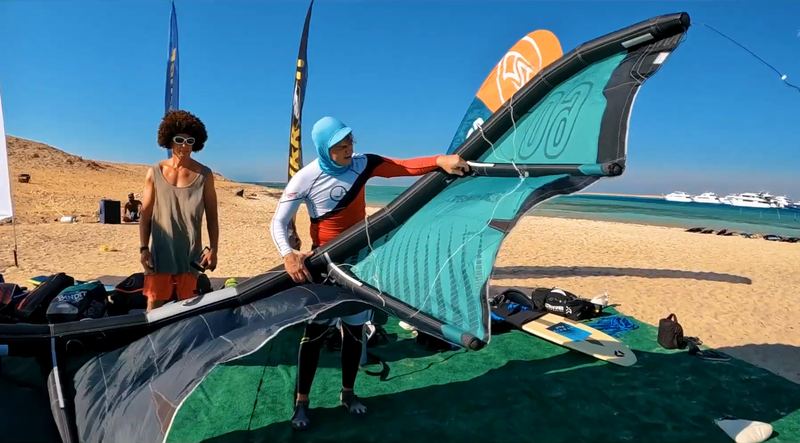
I'd still bring a harness you're used to and your own rash vest or wetsuit. They're light, and you'll be wearing them all week.
Questions
What kitesurfing equipment do I need?
The main parts are a kite, bar and lines, board and harness, plus a kite safety leash with its own release and an accessible line cutter. An inflatable kite needs a pump, clothing should suit the conditions, and I'd recommend a watersports helmet and a certified buoyancy aid compatible with your harness for beginners. An impact vest alone doesn't replace a buoyancy aid; check local rules and your equipment manual too.
What should I buy first after a kite course?
A harness. It has to fit your body, it costs far less than a kite and you can use it with rental gear. Buy the kite and bar last, once you know where and in what wind you'll ride most.
Is it worth buying used kitesurfing gear?
Yes, if the price reflects the condition and the equipment suits you. Check the kite for leaks and canopy damage, and the board's structure and binding attachments; before buying, have a specialist check kite and bar compatibility and the complete safety system.
What board should a beginner kitesurfer buy?
A twin tip, the symmetrical board you ride in both directions without turning it around. Within the range suitable for your weight and conditions, I'd go a little bigger for earlier planing and easier upwind riding. Follow the specific model's size chart and try it if you can.
Do I need my own kite gear for a kite holiday?
No. On the kite safari in Egypt, full kite gear rental costs 300 EUR for 6 days and a twin tip alone 60 EUR for 6 days (2026 prices), with pumps and a compressor on board.
Sources
- ISO 21853:2020 sets tests for bar and safety-leash release systems; GKA describes labels for tested and certified products global-kitesports.org (checked 18 October 2026)
- Wetsuit starting points: 5/4 mm for 7-10 °C (45-51 °F) with sealed seams, boots and gloves, plus a hood in the cold; 4/3 mm for 11-14 °C (52-58 °F) with sealed seams and boots or gloves as needed; 3/2 mm for 15-18 °C (59-65 °F); 2 mm spring suit from 19 °C (66 °F); account for air, wind, session length and cold tolerance www.vissla.com (checked 18 October 2026)
- Kite safari 2026 price list: full kite gear rental 300 EUR / 6 days, twin tip 60 EUR / 6 days; compressor, pumps and beach boys (carry and pump up gear, help with launching and landing) included paradisekitesurf.cz (checked 17 October 2026)
- A harness is usually the first piece of gear people buy; beginners should pick an all-round kite from a brand common at their beach for service and resale; avoid a first board that is too small www.youtube.com (checked 18 October 2026)
- With used gear, read listings and check repair locations; Evan selects an affordable board and a separate pump with the right valve adapter; his expected board replacement is personal, not a statistic about most riders www.youtube.com (checked 18 October 2026)
- A safety system sheds most pull, not necessarily all of it, and needs unobstructed travel along the safety line; the kite leash has its own release and both releases should be tested before every use www.ikointl.com (checked 18 October 2026)
- IKO Equipment: line cutter in the harness, watersports helmet, students need at least 50 N buoyancy with a harness-compatible aid; seat and waist harness differences; open-cell foils for land and closed-cell water-relaunchable foils for water; board width matters d8.ikointl.com (checked 18 October 2026)
- An impact vest cushions impacts; Mystic explicitly states that the Impact Under Vest is not a buoyancy aid www.mysticboarding.com (checked 18 October 2026)
- CORE Pace Pro is compatible only with Sensor 4; its manual requires an approved PFD, kite sizing for ability and wind, and preflight system checks; it describes inflation with a pressure gauge ridecore.com (checked 18 October 2026)
- Twin tip sizing depends on weight, ability and conditions; a larger board helps early planing and upwind riding; use the specific model's size chart www.duotonesports.com (checked 18 October 2026)
- Check kite inflation, canopy, lines, board damage and cracks, and strap attachments; seek professional inspection if unsure kiteandwingwa.org.au (checked 18 October 2026)
- Inspect harness shell, load-bearing webbing and stitching, hook and closure; retire structurally damaged harnesses; assess fit under load rideengine.com (checked 18 October 2026)
- The Flysurfer SOUL closed-cell foil manual describes water relaunch and drainage flysurfer.com (checked 18 October 2026)
- Duotone Kite Manual describes securing the kite while preparing to inflate and connecting the pump adapter to the valve a.storyblok.com (checked 18 October 2026)