Best time to kitesurf in Egypt: a month-by-month guide
Wind, air and water temperature for every month around Hurghada, what to wear on the water, and how Safaga, Marsa Alam and Dahab differ through the year.
Level: Beginner - improver
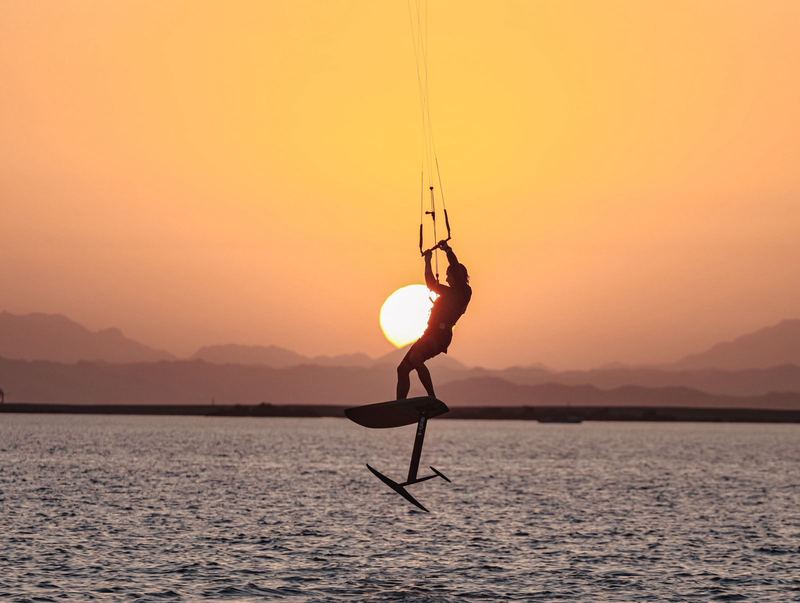
The best time to kitesurf in Egypt for the most wind is June to September: around Hurghada these are the windiest months of the year. From November to February the wind is weakest, but the sea still averages 23-27 °C, so a winter trip works too, with a bigger kite and a wetsuit. In spring (March to May) and in October the wind sits in between and the days are less hot than in summer.
I kitesurfed in Hurghada in April 2023. The monthly figures come from 3 sources: relative wind from a NASA climate model, air temperature from the Egyptian Meteorological Authority and sea temperature from NOAA's satellite and buoy record (OISST).
The wind figures come from a climate model, so they show how the wind changes through the year at one place, not the wind on a particular beach.
Kitesurfing Egypt season at a glance
- Windiest: June to September. August and September score 100 in the NASA POWER model for Hurghada, June 94, July 92.
- Calmest: November to February, at 72-76 % of the peak.
- In between: March to May (80-82) and October (84).
- Warmest water: July to October, 28-29 °C on average off Hurghada.
- Coolest water: February and March, 22.6 °C on average.
- Rain: practically none. Even November, the wettest month, averages 2.2 mm in Hurghada.
- Wind direction: mostly northwest around Hurghada, northwest to north-northwest in Safaga, north-northwest in Marsa Alam and north to north-northwest in Dahab.
Hurghada wind season and temperatures by month
For Hurghada, 3 values per month. Wind is a relative index from NASA POWER (100 = windiest month of the year). Air temperature is the average daily high and low from the Egyptian Meteorological Authority (1981-2010). Water is the average sea surface temperature off Hurghada from NOAA OISST (2001-2025), rounded to whole degrees.
Lycra is a thin top (rash vest) against sun and wind, a shorty is a wetsuit with short arms and legs, and a full suit covers arms and legs completely.
| Month | Wind index | Air high / low | Sea | Wetsuit |
|---|---|---|---|---|
| January | 75 | 22 / 11 °C | 23 °C | yes, full suit |
| February | 76 | 23 / 12 °C | 23 °C | yes, full suit |
| March | 81 | 25 / 14 °C | 23 °C | yes, full suit |
| April | 80 | 29 / 18 °C | 23 °C | thin suit or shorty |
| May | 82 | 32 / 22 °C | 25 °C | thin suit or shorty |
| June | 94 | 34 / 26 °C | 26 °C | Lycra |
| July | 92 | 35 / 27 °C | 28 °C | Lycra |
| August | 100 | 35 / 27 °C | 29 °C | Lycra |
| September | 100 | 33 / 25 °C | 28 °C | Lycra |
| October | 84 | 31 / 22 °C | 28 °C | Lycra |
| November | 72 | 27 / 17 °C | 27 °C | thin suit or shorty |
| December | 74 | 23 / 13 °C | 25 °C | full suit |
The sea changes far less than the air: between the coldest and the warmest month it moves by about 6 °C, while daytime highs move by about 13 °C.
Do you need a wetsuit in Egypt?
O'Neill's wetsuit guide recommends a UV shirt or Lycra for water from 26 °C, a 1 mm wetsuit for 21-25 °C and a 2 mm suit or shorty for 18-20 °C. The same guide points out that wind chill matters, because the longer your body is above the water, the more the wind and air temperature cool you down. On a kite you spend most of the session above the water.
Applied to Hurghada:
- June to October: the sea averages 26-29 °C. Lycra and sun protection are enough for most people.
- April, May and November: the sea is at 23-27 °C. A thin suit or a shorty, depending on how easily you get cold.
- December to March: the sea is around 23-25 °C, daytime highs are 22-25 °C and nights drop to 11-14 °C. I would pack a full wetsuit, plus a warm layer for the evening on the beach or on deck.
These are open-sea averages from satellite and buoy data. Local guides give lower winter numbers: the IKSURFMAG travel guide for El Gouna gives about 19 °C water for its winter season and recommends a 4/3 mm full suit for January and February.
If you are going on a kite safari on a boat, the kite safari packing list covers the rest of the bag.
Hurghada vs Safaga, Marsa Alam and Dahab
All 4 places have wind all year, but the shape of the year differs. Each index is relative to that place's own windiest month.
| Place | Windiest months (index) | Calmest months (index) | Prevailing direction | Sea, coldest / warmest month |
|---|---|---|---|---|
| Hurghada | Aug, Sep (100), Jun (94) | Nov (72), Dec (74), Jan (75) | northwest | 22.6 / 29.0 °C |
| Safaga | Sep (100), Jun, Aug (99) | Nov (74), Jan (75), Dec (76) | northwest to north-northwest | 22.6 / 29.1 °C |
| Marsa Alam | Sep (100), Jun (98) | Nov (80), Oct (82), Jul (84) | north-northwest | 22.9 / 29.9 °C |
| Dahab | Jun (100), Sep (98) | Jan (74), Dec (75), Nov (76) | north to north-northwest | 22.1 / 28.2 °C |
Hurghada and Safaga
Hurghada and Safaga follow almost the same curve: a strong summer, a calmer stretch from November to February and steady spring months. If you want the best odds of wind on a beach holiday, June to September is the time. For an overview of the kite stations along this coast (centres with lessons and rental), see kitesurfing in Hurghada and El Gouna.
Marsa Alam
Marsa Alam has the flattest year of the 4. Even its calmest month reaches 80 % of the peak, so the gap between summer and winter is smaller than further north. It also has the warmest sea, by a few tenths of a degree in winter and about 1 °C in summer.
Dahab
Dahab is on the Sinai side, on the Gulf of Aqaba. In the model its windiest month is June, and spring there climbs faster than in Hurghada: May already scores 91. For Dahab the model cell lies mostly over the Sinai mountains, so treat its curve as a rough guide only. The sea is the coolest of the 4, 0.4-1 °C below Hurghada depending on the month. The guide to kite spots in Egypt compares the spots themselves.
Kite size by season
The lighter the wind, the bigger the kite you need for the same pull. For beginners, moderate wind is often more comfortable for the first lessons than a strong summer breeze. For everyone else, a winter trip mainly means a bigger kite in the bag. If you are unsure what to bring for your weight and the expected wind, the kite size calculator gives you a starting point.
Easter and summer holidays
Easter 2027 falls on 28 March. In the Hurghada data March has a wind index of 81, sea around 23 °C and daytime highs around 25 °C, so pack a full wetsuit. Summer school holidays in July and August fall in the windiest and hottest part of the year: wind index 92-100, daytime highs of 35 °C and sea at 28-29 °C.
Kite safari dates for 2026 and 2027
The kite safari in Egypt run by Mohamed from Paradise Kitesurf lasts 8 days and 7 nights from Hurghada. The crew picks the spot by the wind, usually Geisum, Abu Minqar or Ashrafi. On days 2 to 6 there are 2 sessions, morning and afternoon, the last one is on day 7, and in the evening your rides are analysed on video (video coaching).
If you can't ride on your own yet, start with a course on the coast. The safari gives the most to riders who already ride on their own after a course. There is also a 6-day beginner course on board (€600 with gear); Mohamed confirms how many instructors come along with your dates.
2026 departures:
- 11-18 April
- 22-29 May
- 10-17 October
- 7-14 November
In the Hurghada data these are spring and autumn months: wind index 72-84, sea temperature 23-28 °C and daytime highs of 27-32 °C. The 2027 dates have not been published yet. If you want to hear when they are, leave your details in the form on the safari page.
How to read the wind data
The wind index comes from NASA POWER, which publishes long-term monthly averages from the MERRA-2 climate model. Each month's average wind speed is divided by the average speed of the windiest month at the same place, so the numbers show which months are windier at one place.
The model is good at showing which months are windier, which are calmer and where the wind usually comes from. It cannot show conditions on a particular beach: a grid cell of roughly 55 × 60 km mixes sea, coast and desert, and local thermal wind on the coast (wind that builds as the land heats up during the day) is often stronger than the model's average. Before a trip, look at the long-term statistics of a weather station or a kite spot close to where you will ride, and at the forecast a few days before you fly.
Questions
What is the windiest month to kitesurf in Hurghada?
In the NASA POWER climate model (2001-2025), August and September are the windiest months around Hurghada, followed by June and July. November to February are the calmest. The wind blows mostly from the northwest.
Do I need a wetsuit for kitesurfing in Egypt?
From June to October the sea off Hurghada averages 26-29 °C, which O'Neill's guide puts in the UV shirt or Lycra range. In April, May and November it is 23-27 °C, so a thin suit or a shorty. From December to March the sea is 23-25 °C, daytime highs are 22-25 °C and the wind cools you on the water, so pack a full wetsuit; shallow lagoons can be cooler than the open sea in winter.
How warm is the Red Sea in winter?
Off Hurghada the sea averages about 23 °C from January to April, with February and March the coldest at 22.6 °C (NOAA OISST, 2001-2025). From January to April Marsa Alam is 0.1-0.8 °C warmer, Dahab about 0.5 °C cooler. These are open-sea averages; shallow lagoons can be cooler in winter.
When are the kite safari dates in 2027?
The 2027 dates have not been published yet. 2026 departures: 11-18 April, 22-29 May, 10-17 October and 7-14 November. You can ask to be notified through the form on the kite safari page.
Is it worth kitesurfing in Egypt in winter?
Yes, if you pack for it. Around Hurghada the open sea stays at 23-27 °C, but from November to February the wind is at 72-76 % of the summer peak in the NASA POWER model, so bring a bigger kite and, from December to March, a full wetsuit.
Sources
- Hurghada (27.25 N, 33.81 E): monthly wind speed at 10 m, relative index Jan-Dec 75, 76, 81, 80, 82, 94, 92, 100, 100, 84, 72, 74 (100 = windiest month); prevailing direction 316-323 degrees; MERRA-2 model, climatology January 2001 - December 2025 power.larc.nasa.gov (checked 16 October 2026)
- Safaga (26.75 N, 33.94 E): relative wind index Jan-Dec 75, 77, 83, 83, 86, 99, 91, 99, 100, 80, 74, 76; direction 322-334 degrees; grid point elevation 297.5 m power.larc.nasa.gov (checked 16 October 2026)
- Marsa Alam (25.07 N, 34.89 E): relative wind index Jan-Dec 88, 87, 89, 85, 87, 98, 84, 92, 100, 82, 80, 88; direction 339-350 degrees power.larc.nasa.gov (checked 16 October 2026)
- Dahab (28.49 N, 34.51 E): relative wind index Jan-Dec 74, 77, 86, 87, 91, 100, 87, 90, 98, 82, 76, 75; direction 337-358 degrees; grid point elevation 585.78 m, i.e. mostly over the Sinai mountains power.larc.nasa.gov (checked 16 October 2026)
- MERRA-2 values used by NASA POWER are on a ½° x ⅝° global grid (about 55 x 62 km at 27° N) power.larc.nasa.gov (checked 16 October 2026)
- Hurghada, mean daily maximum and minimum air temperature Jan-Dec (°C): 21.7/11.2, 22.7/11.7, 25.4/14.4, 29.3/18.3, 31.8/22.4, 33.9/25.5, 35.0/27.1, 35.1/27.1, 33.3/24.9, 31.3/21.5, 27.0/17.0, 23.2/13.0; mean monthly rainfall at most 2.2 mm (November); Egyptian Meteorological Authority, 1981-2010 worldweather.wmo.int (checked 16 October 2026)
- Sea surface temperature, monthly means of daily NOAA OISST v2.1 values 2001-2025 (own calculation). Off Hurghada (27.125 N, 33.875 E) Jan-Dec (°C): 23.3, 22.6, 22.6, 23.2, 24.9, 26.4, 28.2, 29.0, 28.0, 27.7, 26.6, 24.8. Coldest/warmest month: Safaga (26.625 N, 34.125 E) 22.6/29.1, Marsa Alam (25.125 N, 35.125 E) 22.9/29.9, Dahab (28.375 N, 34.625 E) 22.1/28.2 coastwatch.pfeg.noaa.gov (checked 16 October 2026)
- Wetsuit guide by water temperature: 26+ °C UV shirt or Lycra, 21-25 °C 1 mm wetsuit, 18-20 °C 2 mm wetsuit or shorty; wind chill and time above water affect how warm you need to be eu.oneill.com (checked 16 October 2026)
- El Gouna kite travel guide: in the winter months the water drops to about 19 °C; in January and February a 4:3 mm full suit is recommended www.iksurfmag.com (checked 16 October 2026)
- Western Easter 2027 falls on 28 March en.wikipedia.org (checked 16 October 2026)
- Kite safari dates 2026: 11.04.-18.04., 22.05.-29.05., 10.10.-17.10., 07.11.-14.11. (8 days / 7 nights) paradisekitesurf.cz (checked 16 October 2026)
- Safari programme: on days 2 to 6 a morning and an afternoon kite session, final session on day 7, evening ride analysis (video coaching); transfer to an island according to conditions (e.g. Ashrafi or Geisum); 6-day beginner course €600 including gear paradisekitesurf.cz (checked 16 October 2026)
- Jana Hrabalová kitesurfed in Hurghada in April 2023 www.youtube.com (checked 16 October 2026)