Kiteboarding surfboards vs twin tips and foil boards: which to choose?
Buy a twin tip after your lessons and stay on it until you can ride upwind without thinking. A surfboard comes with waves and downwinders, a foil with light wind and deeper water.
After your lessons, buy a twin tip. It's the board you learned on, it rides both ways, and it will take you a long way: upwind, your first jumps, choppy water. Kiteboarding surfboards make sense once waves or long downwind runs start pulling at you. A foil board is for riding in light wind, and it's worth trying once you go upwind and turn without having to think about it.
Each type needs different turning and waterstart skills and suits different conditions. Choose by that first, and leave brand and colour for later.
The 3 kiteboard types side by side
| Twin tip | Surfboard | Foil board | |
|---|---|---|---|
| Shape | both ends identical | nose at the front, fins at the tail | board with a mast and wings below |
| Direction | both ways, no foot switch | nose first; carve and continue toeside without switching feet | nose first; carve and continue toeside without switching feet |
| Foot attachment | straps with pads, or boots | straps or strapless | 2-3 straps or strapless |
| Best for | flat water, chop, jumps | waves, downwinders | light wind, deeper water |
| When to switch | right after your course | once you ride independently and want waves | once you ride upwind and turn with confidence |
Twin tip: the board you start on
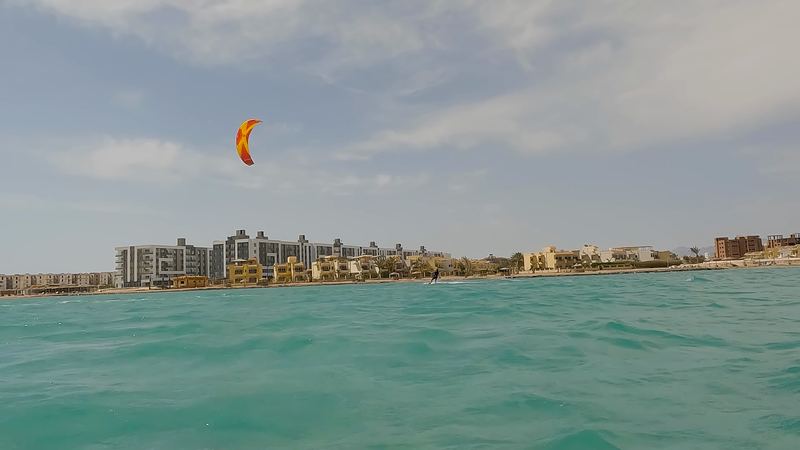
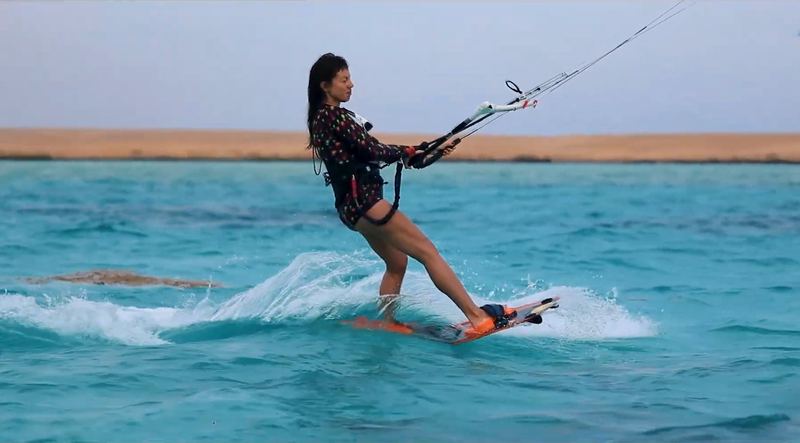
A twin tip has 2 identical ends. When you turn, your feet stay where they are: you slow down, bring the kite across and ride back the other way in the same stance. It's forgiving and easy to handle, which is why it's the most common kiteboard and the one you learn on.
After your course I'd choose a bigger twin tip within the range the manufacturer recommends for your weight in that particular model. A bigger board planes earlier and goes upwind more easily, which also helps in lighter wind. Match the size to your weight, level and usual conditions. The kiteboard size guide goes through length and width, and the kite size calculator gives you a starting point for the kite.
A twin tip also handles chop, the short messy waves the wind kicks up on a lake or the sea. And it's the board for jumping. If you already ride independently and want to get off the water, you don't need a new board. Spend the time learning to edge hard, digging the board's rail into the water, and to work the kite.
On the Red Sea kite safari I go on, most of the kiting happens in shallow lagoons. I'd take a twin tip for that water. Abu Mungar, for example, has shallow, calm water and a sandy bottom. If you don't own a board yet, the 2026 safari price list includes twin tip rental at €60 for 6 days.
Rocker and flex on a twin tip
After a course I'd pick a softer freeride twin tip, a board for everyday riding for fun. A softer board is more comfortable and forgiving. Manufacturers describe its stiffness as flex. I'd look at a stiffer board once you want more pop, the spring off the edge as you jump.
Look at the board's curve too, known as rocker. More curve helps in chop and softens landings. A flatter board goes upwind more easily. If you're still struggling to ride upwind, I'd give that priority. A rounded outline makes carving easier, while a squarer shape adds speed and pop. For a first board I'd look for a comfortable ride rather than a board focused on jumps and tricks.
On a twin tip your feet are held by straps over soft footpads, or by boots like on a wakeboard. The pad sits on the board under your foot; it doesn't hold your foot in place by itself. I'd start with straps and pads; the straps vs boots guide covers the difference.
Surfboard: when waves start pulling you in
A kiteboarding surfboard, or directional, has a nose and a tail with fins. It rides nose first. You can change direction with a downwind carve, or jibe, going from your heel edge to the edge under your toes, known as toeside. You can keep riding that way without switching your feet. The foot switch is another skill: you swap your front and back feet to return to riding heelside. I'd practise both the carve and the foot switch on flat water or in small waves first.
You can ride a surfboard with straps or without them, known as strapless. Pads stuck to the deck or surf wax provide grip under your feet. You can have pads on a board with straps too. In waves a lot of people now ride strapless, while straps give you more control in big surf. More volume means the board planes earlier and goes upwind better, which helps in lighter wind.
A surfboard is also the tool for downwinders, longer runs with the wind from one spot to another where you pick up every bump on the way. There are beginner-friendly surfboards out there. Still, I wouldn't buy one as my first board after a course. A twin tip lets you build on what you learned in lessons; a surfboard adds carving turns and riding toeside, with foot switches to learn later.
I had to be kicked into the waves in October 2024. Afterwards I wrote on Instagram that they're the best playground there is. If they're pulling at you, don't wait until you feel "done" with the twin tip. I'd go once you can reliably ride upwind and get back to where you started.
Foil board: riding above the water
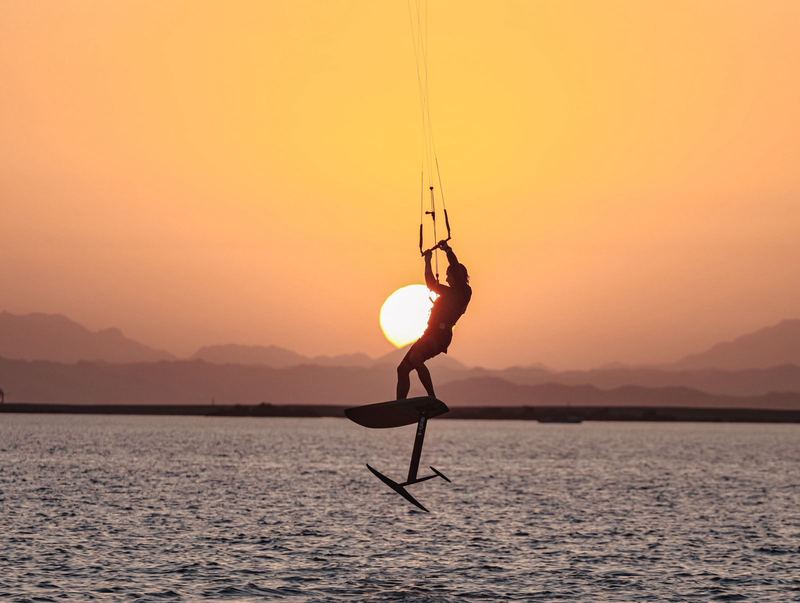
A kite foil board has a mast underneath with wings at the bottom. Once you pick up speed, the wings lift the board out of the water and you ride above the surface. The board no longer drags through the water, which is why a foil glides in wind where a twin tip still just wallows. For other options, see the article on light wind boards.
I'd only start foiling once you go upwind and turn without thinking about the kite. You're learning to balance all over again, so I'd want kite control to feel familiar. Check the entry requirements with the school where you plan to learn.
A foil is sharp. The wings have sharp edges and the mast can hurt you badly in a crash, so wear a helmet, an impact vest and neoprene booties for your first sessions. The helmet and impact vest guide has more on protection.
For learning you want a short mast and a bigger front wing. Armstrong lists 45, 60 or 72 cm masts for rookie kite foilers. With a short mast you're closer to the surface and you fall from lower down.
A foil needs enough depth with safety clearance below the whole assembly. Follow the manual for your particular foil; mast length alone is not enough. Before launching, check the depth and make sure the bottom is clear of obstacles where you'll launch, ride and return. Leave plenty of room from other riders too. A sloping bottom doesn't mean you've reached enough depth to start. Even a short mast doesn't automatically make a shallow lagoon suitable for foiling.
Which kiteboard when
- Straight after your course: a twin tip, towards the larger end of the range for your weight and that model. You're buying the board you'll learn to ride upwind on.
- You ride independently and want to jump: stay on the twin tip, it's built for jumps and chop. When you buy the next one, try a stiffer board with more pop.
- The wind at your local spot is often light: a bigger light wind twin tip, or a foil if you already ride upwind with confidence.
- You want waves or downwinders: a surfboard, ideally alongside your twin tip.
The kitesurfing equipment guide covers what to buy first and what can wait.
Questions
What board should I buy after kitesurfing lessons?
A twin tip, towards the larger end of the range recommended for your weight in that model's size chart. It rides both ways without switching your feet, and it's what you learned on. A bigger board planes earlier and goes upwind more easily; factor in your wind conditions too.
What is the difference between a twin tip and a kiteboarding surfboard?
A twin tip has 2 identical ends and rides in both directions. A surfboard has a nose and a tail with fins and rides nose first; after a downwind carve you can keep riding toeside, on the edge under your toes, without switching your feet. Surfboards are mainly for waves and downwinders.
When can I start kite foiling?
I'd start once you can ride upwind and turn confidently without concentrating on flying the kite. Check the entry requirements with the school where you plan to learn. Wear a helmet, an impact vest and neoprene booties for your first sessions, because foil wings are sharp.
Can you kite foil in a shallow lagoon?
Only where you have checked that the water is deep enough, with safety clearance below the whole foil assembly as required by its manual. Before launching, check the bottom, obstacles and room to ride and return; mast length or a sloping bottom alone is not enough. Keep the shallow parts of the lagoon for twin tips.
Sources
- Twin tips are the most common kiteboards, symmetrical and bidirectional without foot switches; forgiving for learning, flat water, chop and jumps; softer flex for comfort and beginners, stiffer for pop; more rocker for chop and landings, less for easier upwind; rounder outline for carving, squarer for speed and pop; size depends on weight, level, wind and the specific model's chart, larger boards plane earlier and go upwind more easily www.duotonesports.com (checked 18 October 2026)
- Twin tips for beginners and freeriding with straps or boots, softer flex is forgiving; surfboards have a nose and a tail with fins and suit waves and downwinders; foils glide in light wind; surfboards with straps or strapless, straps give control in big waves; pads or wax provide grip; foilboards with 2, 3 or no straps www.duotonesports.com (checked 18 October 2026)
- Kite surfboards: larger volume for early planing and better upwind performance (heavier riders, light wind); beginner-friendly surfboards exist www.duotonesports.com (checked 18 October 2026)
- Surfboard foot changes are taught separately after carving to toeside; front and back feet swap, wax can be used between straps www.iksurfmag.com (checked 18 October 2026)
- A heel-to-toeside carve lets a surfboard rider change direction without switching feet; practise on flat water or in small waves www.iksurfmag.com (checked 18 October 2026)
- Kite Foil Academy teaches heelside and toeside turns separately from foot switches: a change of direction does not always require changing foot position www.foil-academy.com (checked 18 October 2026)
- Surf pads provide deck grip as an alternative to wax; they do not attach the foot to the board www.duotonesports.com (checked 18 October 2026)
- The Kitesurf Centre requires confident independent riding and upwind ability for its foil lessons; this does not establish identical requirements at all schools www.thekitesurfcentre.com (checked 18 October 2026)
- First foil attempts: helmet, neoprene boots and impact vest; the foil is sharp, wing tips are sharp and the mast can cause serious injury; beginners use a larger front wing and a shorter mast, closer to the surface www.kitemana.com (checked 18 October 2026)
- Armstrong mast length guide: kite foil, Rookie/Intermediate rider, mast M45, M60 or M72 (45, 60, 72 cm) brettsport.imgbolt.de (checked 18 October 2026)
- CORE SLC requires water at least mast length + 50 cm when entering and leaving to avoid underwater obstacles; evidence for clearance, not a universal numerical rule for all foils ridecore.com (checked 18 October 2026)
- Duotone: follow the foil manual, allow sufficient depth for the assembly, check surroundings and obstacles, keep a safe distance from other water users; ground contact causes crashes and injuries a.storyblok.com (checked 18 October 2026)
- Safari price list 2026: twin tip rental 60 EUR / 6 days; safari islands have shallow lagoons; Abu Mungar has shallow calm water and a sandy bottom paradisekitesurf.cz (checked 18 October 2026)
- Video: KitePaddleSurf compares beginner kite foil boards (longer, wider, rocker, strap inserts) with thin boards for riders who already foil www.youtube.com (checked 18 October 2026)
- Jája on Instagram, 13 Oct 2024: they had to kick her into the waves, best playground www.instagram.com (checked 18 October 2026)