After kite lessons: your first 10 solo sessions
Before riding without an instructor, you need controlled starts, speed control, stops and safety skills. Choose a suitable spot and arrange help with launching and landing beforehand.
After kite lessons, you can ride without an instructor once you have mastered safety procedures, controlled starts, speed control and stops. Have your instructor assess your readiness, choose suitable wind and a suitable spot, and arrange help with launching and landing. If you're nervous, work through the skills you feel unsure about with your instructor.
Never kite alone at the spot, even after your first 10 sessions. Other kiters being there does not mean someone is watching you or that you have rescue cover.
What bothers me is how many kite courses are rushed. You learn to get up on the board without knowing how to read the wind or handle trouble, putting yourself and others at risk. Fill those gaps with an instructor. I go through what a good course should teach you in my guide on how to learn kitesurfing.
What to know before you ride without an instructor
Go through this list honestly. Anything you're not sure about, practise again with an instructor rather than on your first day out alone.
- Use your safety system. The main quick release should remove most of the kite's pull, but the safety leash keeps it attached to your harness, the belt that takes the pull. If the kite loops uncontrollably in a death loop or pulls dangerously, let go of the bar. If the pull continues, activate your bar's quick release as instructed by the manufacturer; on a push-away system, push the handle away from you. If dangerous pulling still continues, the last resort is to activate the leash release and separate completely. The loose kite can endanger people downwind. Practise the movements and sequence with an instructor on your own equipment. Before every session, check that the releases work and are correctly assembled according to the manual.
- Start, control your speed and stop. A waterstart, getting onto the board from the water, must come with controlled stopping and speed control by edging the board. If you're missing any part, keep working with an instructor.
- Check your gear. Lines free of knots and twists, all the same length, valves closed and secured.
- Relaunch the kite from the water. Use the procedure for your model that you practised during lessons, following the manufacturer's manual.
- Get back to your board. Body dragging means letting the kite pull you through the water without the board. It's how you get back to a board that got away from you. Here's how body dragging works.
- Rescue yourself. Self rescue is how you get yourself and the kite to shore when the wind dies or the kite won't relaunch. I explain it step by step in kitesurfing self rescue.
Which wind and spot to pick
Wind direction decides where you end up when something goes wrong.
| Wind | Where it blows | For your first solo sessions |
|---|---|---|
| Side-onshore | diagonally from the sea onto the beach | best, if the kite drops it carries you towards shore |
| Sideshore | along the beach | good, you can ride out and come back |
| Onshore | straight from the sea onto the beach | not yet, it pushes you onto the beach and only riders who go upwind straight away get out |
| Offshore | from the beach out to sea | no, it carries you away from shore, nobody should ride it without a chase boat |
A knot is a unit of speed: 1 knot equals 1.852 km/h. Check which units your forecast uses. Start in wind no stronger than force 4-5 Beaufort, up to about 21 knots, always within your equipment's range and your ability. If the wind is gusty, don't go out.
Gusts also come from whatever stands in the wind's way. I know this from snowkiting at Moldava: when the wind blows from the forest and we're close to it, the kite becomes unstable in the turbulent wind and we have to move further away. By the water the same goes for trees, buildings or dunes upwind, so check behind you before launching.
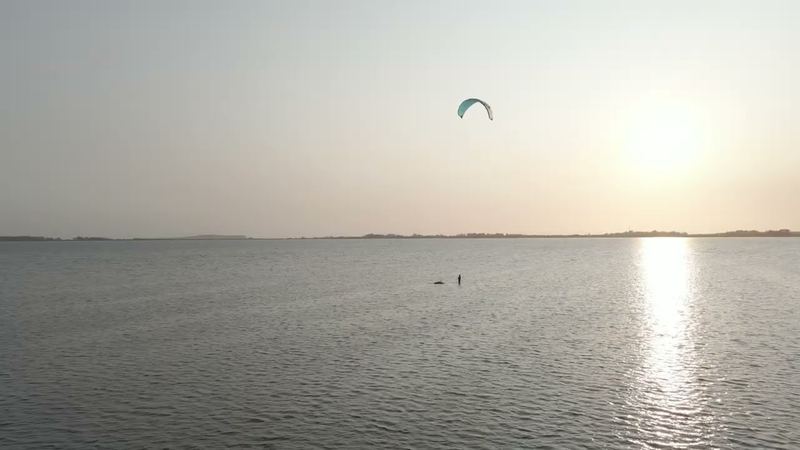
Look for a place where you can stand, with space around you and other kiters on the water. Allow at least 3 line lengths of space to land, launch well downwind of others and choose a backup landing spot further downwind. At Wiek on Rügen, where I keep coming back, you can stand up to 450 m from shore and the sheltered bay keeps the water flat, which is exactly what you want for your first runs.
Launching and landing
Launching and landing bring you closest to people and obstacles. Arrange help beforehand with someone who knows how to launch and catch a kite. Don't expect someone on the beach to guess what you need.
Agree on signals beforehand, because with the wind and the length of your lines you won't hear each other:
- thumbs up: I'm ready, let go of the kite
- tapping your head with a flat hand: I want to land, please catch my kite
I'd learn to self-launch and self-land with an instructor. As long as there's someone on the beach you can ask, there's no reason to do it on your first sessions. Who gives way to whom on the water and where to launch is in my guide to right of way and beach etiquette.
A plan for your first 10 sessions
I'd pick 1 goal for each session. Use this table to revisit skills from your course and choose further goals as you progress, without deadlines. You already need starts, speed control, stops and safety skills before riding without an instructor. Practise anything you haven't mastered with them.
| Suggested sessions | What to focus on | What to check |
|---|---|---|
| 1-2 | revisit kite control, relaunching and body dragging | you can relaunch and retrieve your board in these conditions |
| 3-4 | revisit starts and stops in both directions | you start left and right and stop under control |
| 5-6 | extend your runs while staying in control | you maintain your chosen speed and stop under control |
| 7-8 | holding your ground, riding at an angle into the wind | after a run out and back you end up roughly where you started |
| 9-10 | turning and riding back and forth | you come back to your launch spot on the water, not along the beach |
On first runs, keep the kite moving in smooth figures of eight on one side of the wind window, turning before it reaches the bottom. Pull the bar in enough to steer, without oversheeting. If the kite tips backwards, that's a backstall: pulling in further won't help, so sheet out to restore airflow. Practise recognising the difference with your instructor; loss of pull can have different causes.
When you keep drifting downwind
Until you can ride upwind, meaning at an angle into the wind, every run takes you a bit further downwind. That's a normal stage, so plan for it. Walking back along the beach with your board under your arm is part of starting out, and nobody on the spot will look twice. So ride where there's a long stretch of open beach downwind that you can land on and walk back along.
When the wind picks up or you're getting tired, head in. In increasing wind, land straight away, preferably with a trained helper. I cover getting back on the water in my guide on how to ride upwind.
Choosing your first kite and board
Kite size depends on wind, your weight, your board and local conditions. The kite size calculator already adjusts its result for the beginner setting, so don't automatically go smaller again. You want a correctly sized kite without excessive pull. Check the result against your model's wind range and the actual conditions at the spot; ask an instructor if you're unsure.
Your board will most likely be a twintip, a symmetrical board you ride in both directions without turning it around.
Your first 10 sessions with help nearby
If you have nowhere to ride at home or nobody to help you launch, you can do this stage on a kite safari in Egypt. The safari I go on has beach boys, crew members on the beach who help you launch and land. You ride in shallow lagoons with a sandy bottom, and a rescue boat is included. On top of the safari price you can book a 3-hour refresher course for €180 or 6 hours for €330, and private lessons are €65 an hour (2026 price list).
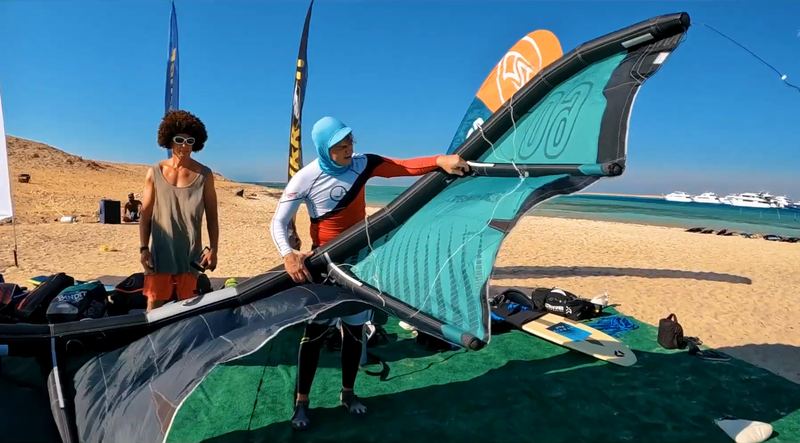
In April 2024 we took 8 beginners along on the safari. We spent the first 2 days on Geisum: day 1 was tough, and by the middle of day 2 everyone was riding. Don't take that as a promise it will go the same way for you: it depends on the wind, the instructor and how much experience you've had.
Questions
Can I kite alone after my kitesurfing lessons?
Ride without an instructor only once you have mastered starts, speed control, stops and safety procedures and your instructor has assessed your readiness. Never kite alone at the spot, and arrange help with launching and landing beforehand. Other kiters being there does not mean you have supervision or rescue cover.
What wind is best for my first solo kite session?
Steady wind blowing diagonally onshore (side-onshore) or along the beach (sideshore), with no gusts. VDWS recommends trying conditions first in no more than force 4-5 on the Beaufort scale, which is up to about 21 knots. Stay off the water in offshore wind unless there is a boat to pick you up.
What should I do if I keep drifting downwind?
Until you can ride upwind, expect to walk back along the beach. Kite where there is open beach downwind that you can land on, and head in early when the wind picks up or you get tired.
How much is a refresher course on the kite safari?
According to the Paradise Kitesurf 2026 price list, a 3-hour refresher course costs €180 and a 6-hour one €330, and private lessons are €65 per hour. They are paid on top of the safari price.
Sources
- Ozone Contact Water V5 uses a push-away quick release; the manufacturer recommends activating and reassembling it before use ozonekites.com (checked 17 October 2026)
- Safety stages: let go of the bar, activate the main quick release, and detach the safety leash as a last resort if dangerous pulling continues www.duotonesports.com (checked 17 October 2026)
- After the main quick release, the kite loses most of its pull but remains attached to the harness through the safety leash www.duotonesports.com (checked 17 October 2026)
- Full separation through the leash release is for extreme emergencies; the loose kite can endanger people downwind; relaunch procedures are model-specific ozonekites.com (checked 17 October 2026)
- IKO teaches waterstart and controlled stop at Level 2I, speed control by edging at Level 3J, after safety systems, relaunch, body dragging and self rescue; the article's session table is a suggested practice plan, not an IKO timetable www.ikointl.com (checked 17 October 2026)
- Progression: smooth figures of eight, early turns and sufficient sheeting-in for steering help keep the kite moving on first runs; checked against video captions www.youtube.com (checked 17 October 2026)
- Progression: a backstalling kite tips backwards; pulling the bar in further does not help, while sheeting out allows airflow to recover progression.me (checked 17 October 2026)
- The calculator already adjusts kite size down for the beginner setting; its result is a starting point affected by model and conditions kitewithjaja.pages.dev (checked 17 October 2026)
- Kite size depends on rider weight, wind, board, riding style and local conditions northactionsports.com (checked 17 October 2026)
- IKO Meteorology, page 149: a knot is a unit of speed, 1 knot = 1.852 km/h; wind speed can use different units d8.ikointl.com (checked 17 October 2026)
- VDWS: never kite alone; do not kite in gusting wind; first try conditions with wind no stronger than force 4-5 Bft; allow at least 3 line lengths for a landing space; check for obstacles in the path of the wind; start well downwind of others; plan an emergency landing place further downwind; check lines (knots, twists, equal lengths) and the quick release; in increasing wind get ashore quickly and land, preferably with trained helpers www.vdws.de (checked 17 October 2026)
- Beaufort scale: force 4 is 11-16 knots, force 5 is 17-21 knots weather.metoffice.gov.uk (checked 17 October 2026)
- Side-onshore wind is the best bet for new riders (easy to get back to shore if the kite drops), sideshore is also good for them; never kitesurf in offshore wind regardless of level, the only exception is with a chase boat; onshore only for riders who can go upwind instantly www.mackiteboarding.com (checked 17 October 2026)
- Hand signals: thumbs up = ready to launch the kite; tapping the head with the palm = I want to land my kite www.surfertoday.com (checked 17 October 2026)
- Wiek (Wieker Bodden, Rügen): the standing area reaches out 450 m and the water is smooth thanks to the sheltered location www.visit-mv.com (checked 17 October 2026)
- Safari price list 2026: refresher course 3 h €180, 6 h €330, private lesson €65/h, beginner course €600 (6-day intensive course) paradisekitesurf.cz (checked 17 October 2026)
- Safari: beach boys help launch and land kites on the beach, a rescue boat is included, shallow calm water with a sandy bottom; the safari is also for beginners who want to progress fast under instructors paradisekitesurf.cz (checked 17 October 2026)
- April 2024: 8 beginners came along on the safari, the first 2 days were training on Geisum, day 1 was tough, by the middle of day 2 everyone was riding www.instagram.com (checked 17 October 2026)
- Video from Jája's channel: first runs at Wiek on Rügen at sunset (June 2023) www.youtube.com (checked 17 October 2026)