Is kitesurfing dangerous? Is it hard?
You can get hurt, but most of the risk is in your hands: a proper course, sensible wind and a safety system you have actually practised. The hard part is the start, when you have to manage several things at once.
Is kitesurfing dangerous? You can get hurt. A German and a Dutch study followed riders through a whole season and counted 7 and 10.5 injuries per 1,000 hours of riding. Most injuries happen during jumps. The other dangerous moments are when a rider loses control of the kite: in gusty or strong wind, near obstacles, and when they can't detach from the kite in time.
Beginners don't jump or do tricks on a course, and the other risks are ones you can do a lot about: learn at a school, ride only in suitable wind, and practise your safety system until your hand finds it without thinking.
If a big kite makes you nervous, that's fine. Nearly every risk behind that fear has a specific cause, and you can shrink it a lot.
What the injury numbers say
The study quoted most often is a German one from 2004. It followed 235 kitesurfers for a season and found 7 injuries per 1,000 hours. During the study 1 rider died and 11 people had severe injuries, mostly fractures. The finding I'd remember is this one: 56% of injuries happened when the rider lost control of the kite and couldn't detach from it. Riders who had a quick release, a fast way to disconnect from the harness, tended to get hurt less. It was a time when not everyone had one. The authors described kitesurfing as a high-risk sport, and in a follow-up review they write that prevention cuts the number of injuries considerably.
A newer Dutch study from 2020 followed 194 riders across 16,816 hours on the water. It found 10.5 injuries per 1,000 hours, which the authors put in the range of other popular sports, contact sports included. The most common were cuts and abrasions (25.4%), bruises (19.8%) and sprained joints (17.5%). Almost a third of injuries (31.8%) were to the foot and ankle. Most happened during a trick or a jump, and the authors describe most injuries as relatively mild.
To me, a big share of the risk sits in what the rider does: where they launch, what wind they go out in, and whether they can let go of the kite in time.
Where beginners get into trouble
Jumps, where both studies found the most injuries, aren't part of a beginner's day yet. For you it's mostly about launching on the beach, the wind and its direction, and the water.
Launching and landing on the beach
The moments I'd watch most closely are the ones on land. On the beach the kite is just as powerful as on the water, and a gust can lift a rider and throw them into whatever is nearby: a car, a wall, rocks, people. You need a clear semicircle of 100 m downwind and to each side, with no people and no obstacles. That's what Duotone asks for in the manual for its Mono kite. As a beginner, always launch and land with a helper, ideally your instructor, and don't hang around on the beach with the kite in the air.
Gusty and strong wind
Kiters measure wind in knots (1 knot is just under 2 km/h). If the wind is gusty, don't go out. While you're still new to riding, stay at force 4-5 on the Beaufort scale or below, which is up to about 21 knots or 24 mph. VDWS, the German association of water sports schools, recommends the same limit when you're trying out new conditions. The risk climbs faster than the wind does, because the kite reacts harder and you have less time to fix a mistake.
Gusts also come from obstacles on the side the wind blows from. At Moldava in the Ore Mountains (Krušné hory) in Czechia, where I snowkite, the kite gets turbulent when the wind comes from the forest and we're close to it, and you have to move further away. On the water it works the same way with buildings, trees and tall dunes on the shore.
Wind direction: offshore and onshore
Offshore means the wind blows from the land out to sea. The water near the beach looks calm and flat, but if the wind drops or you crash, it carries you away from shore. Onshore blows straight at the beach and pushes you towards it and everything on it. So avoid offshore completely and be careful with onshore. For learning, the nicest wind blows along the shore or at an angle onto it.
The water
Kitesurfing is a water sport, so you should be a strong swimmer and ride with a buoyancy aid. On a course you learn self rescue, which is how to get back to shore on your own when the kite won't fly anymore: you pull the quick release, stay on your leash, wind up the lines, and the kite and board keep you afloat like a raft. And one rule always applies: never kite alone.
Safety systems: what protects you
You hold the kite by the bar, and the bar is clipped through a loop to your harness, a belt around your waist or hips. The harness takes the kite's pull, so you're not holding it all with your arms. That gives you 3 levels of protection:
- Let go of the bar or push it away. The kite loses much of its pull. This is the first thing a course teaches you.
- Quick release. Pull the handle on the loop, you disconnect from the harness, and the kite drops and hangs on a single safety line attached to your leash.
- Quick-release leash. If you need to, you disconnect from the kite completely. So during the course and after it, ride only with a bar that has a safety system and a leash you can open in an emergency.
Practise the quick release several times on your course, even if it feels pointless. In the 2004 study, 56% of injuries happened at exactly the moment a rider couldn't detach.
Then there's the helmet, and you always need one if your board is leashed to your leg. In the German study nobody with a head injury was wearing one, and in every one of those cases the board leash had flung the board back into their head. A board leashed to your leg adds its own risk of head injury.
Is kitesurfing hard to learn?
You'll get the hang of steering a kite fairly quickly. What's hard is putting it all together at once: the kite overhead, the board under your feet, your own body and a wind that keeps changing. I still know that feeling from learning to jump. It feels like I have to do a whole pile of things at the same moment, and as soon as I focus on one, I forget another. Beginners get the same feeling at the waterstart.
The waterstart is the moment you get up from the water onto the board and the kite's pull lifts you into riding. Before that you spend time on the beach and body dragging, where the kite pulls you through the water without a board. Body dragging is also how you get back to your board when you lose it and it isn't leashed to your leg. After your first rides comes upwind, riding at an angle into the wind so you can get back to where you started. Expect upwind to take a while.
You don't need huge arm strength, because the harness takes the pull. Kiting is still hard work for the body, so it pays to arrive in reasonable shape. How long it takes to learn kitesurfing varies a lot with the wind, the instructor and how the kite clicks for you. The full path from first lesson to riding on your own is in my guide on how to learn kitesurfing.
Why you shouldn't teach yourself
The hardest part is getting the kite into the air safely. Instructor Alex from Kitesurf College has a name for it, the launching paradox: you have to judge the strength, quality and direction of the wind, pick the kite size, lay it out correctly to the wind, check the lines, hook in, stand at the right angle, and keep a hand ready for the quick release the whole time. That takes experience you mostly gain by launching. It's the part that's hardest to learn without an instructor.
I don't think rushed fast-track courses are enough. A good course teaches you safety, how to read the wind and the spot, how to choose gear and how to handle an emergency, so that on a real spot you're not a danger to yourself or to other kiters. When choosing a kite school, ask whether the course also teaches self rescue and reading the wind.
A trainer kite on land helps a lot too. If you've flown one in a field beforehand, steering a kite won't be new to you when your course starts.
What to check before you first go in the water
- A school with certified instructors (IKO or VDWS) and a course that also teaches self rescue and reading the wind.
- Shallow water where you can stand, ideally with a sandy bottom and no rocks or coral.
- Wind along the shore or at an angle onto it, steady and never offshore.
- Never alone, not even after the course.
- A buoyancy aid every session, and a helmet whenever your board is leashed to your leg.
- Water shoes where there are shells, rocks or coral, which cut feet easily.
- A quick release you've pulled yourself several times on your course.
A shallow lagoon as a classroom
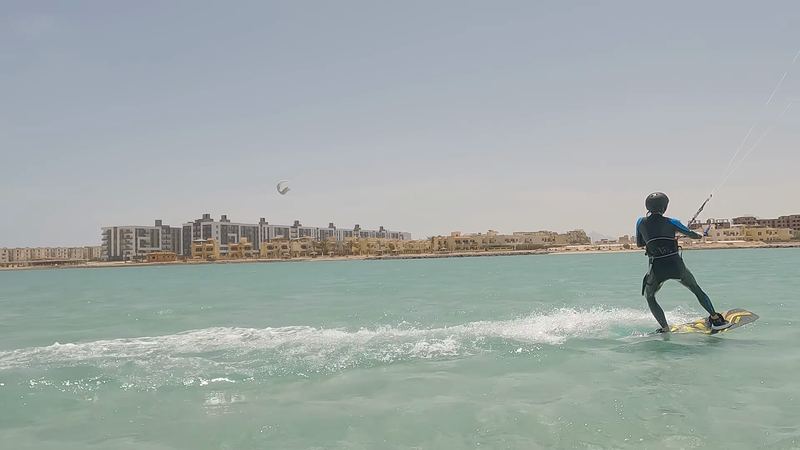
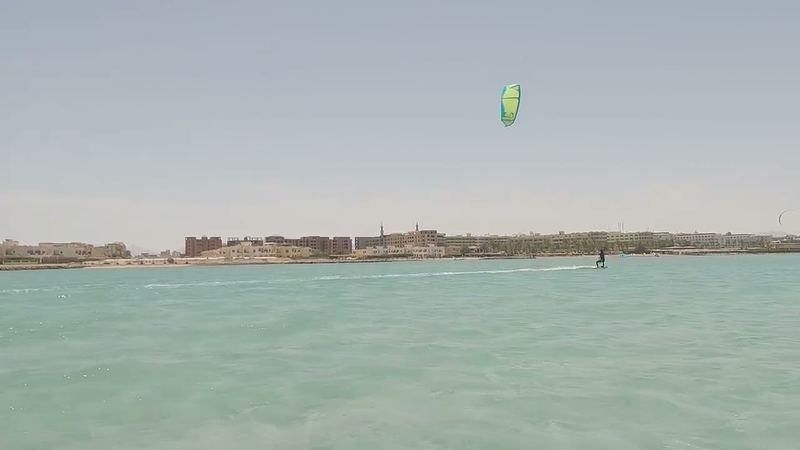
Shallow water makes the start much easier. When you fall, you stand up, walk to your board and try again, instead of body dragging around deep water looking for it. That's why beginners like to learn in lagoons with a sandy bottom, around Hurghada in Egypt for example.
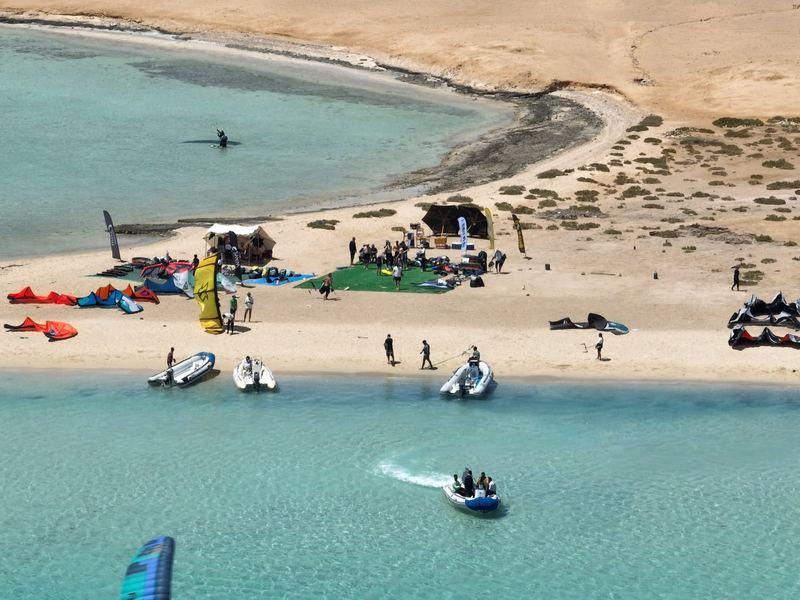
You can also learn on the Red Sea kite safari I go on. The beginner course is paid on top of the safari price: €600 for a 6-day intensive course with equipment included. If you've done a course before but haven't ridden for a long time, you can add a 3-hour refresh for €180. On the beach, beach boys from the crew inflate your gear and help with launching and landing, and there's a rescue boat on the water. One of the islands the boat visits, depending on the wind, is Abu Mungar, with a shallow, calm lagoon and a sandy bottom.
In April 2024 we took 8 beginners on the safari and spent the first 2 days on Geisum. Day 1 looked tough, and by the middle of day 2 everyone was riding. Take that as one particular group, not a promise. A lot depends on the wind, the instructor and how the kite clicks for you. It's also a week on a boat: the course runs at whichever spots the crew picks each day from the forecast.
Questions
Is kitesurfing dangerous?
You can get hurt: studies from Germany (2004) and the Netherlands (2020) counted 7 and 10.5 injuries per 1,000 hours of riding, and in the Dutch one the most common were cuts, abrasions, bruises and sprains. Most injuries happen during jumps. The other dangerous moments are when a rider loses control of the kite and cannot detach from it.
Is kitesurfing hard to learn?
Steering the kite makes sense fairly quickly. The hard part is putting kite, board and body together, especially at the waterstart and later when riding upwind. How many hours it takes depends on the wind, the instructor and you.
Can you teach yourself to kitesurf?
I would not. The hardest and riskiest part is getting the kite into the air safely and landing it again, and that is exactly what is hardest to learn without an instructor. Duotone's manual says plainly that anyone who cannot ride yet should go to a licensed kite school.
What is a quick release?
A release on the loop that connects your bar to the harness. Pull it and you are disconnected from the kite's pull: the kite drops and stays attached by a single safety line. In the 2004 study, 56% of injuries happened when riders could not detach from the kite.
Do I need to be able to swim?
Yes. Kitesurfing is a water sport, so you should be a strong swimmer and ride with a buoyancy aid. On a course you also learn self rescue: getting yourself and your kite back to shore on your own.
Sources
- German prospective study (Nickel et al., 2004): 235 kitesurfers over 1 season, 7 injuries per 1,000 hours, 1 fatal accident and 11 severe injuries; 56% of injuries attributed to inability to detach the kite; riders with a quick release tended to have fewer injuries; authors' conclusion: kitesurfing can be considered a high-risk sport pubmed.ncbi.nlm.nih.gov (checked 17 October 2026)
- Review of the same study (Petersen et al., 2005): none of the riders with head injuries wore a helmet, in all cases the board was flung against the head by the board leash; the most common injury situation was the jump; conclusion: a comparably high injury rate that preventive measures can reduce considerably pubmed.ncbi.nlm.nih.gov (checked 17 October 2026)
- Dutch prospective study (van Bergen et al., 2020): 194 riders, 16,816 hours, 10.5 injuries per 1,000 hours, in the range of other popular (contact) sports; cuts and abrasions 25.4%, contusions 19.8%, joint sprains 17.5%; foot and ankle 31.8%; most injuries during a trick or jump; most injuries relatively mild pubmed.ncbi.nlm.nih.gov (checked 17 October 2026)
- VDWS (German association of water sports schools): never kite alone; do not kite in gusty wind; first check out conditions when the wind does not exceed force 4-5 Bft; danger increases exponentially with wind strength; if you can no longer reach the shore, pull the quick release, recover the kite and swim for the shore; use kite and board as a life raft www.vdws.de (checked 17 October 2026)
- Duotone Mono 2025 manual: riders who cannot kite yet should attend a licensed kiteboarding school; kiting strains the body; only for strong swimmers with a buoyancy aid; bar with a safety system and a quick-release kite leash; helmet with a leashed board; 100 m semicircle downwind and to the sides clear of people and obstacles; avoid offshore wind, be careful with onshore wind; Beaufort table (force 4 = 10.6-15.5 knots, force 5 = 15.6-20.9 knots, 17.9-24.0 mph) a.storyblok.com (checked 17 October 2026)
- Safari price list 2026: beginner kiteboarding course 600 EUR (6-day intensive course including kite equipment), refresh course 3 hours 180 EUR; beach boys help with inflating, launching and landing; rescue boat; shallow lagoons; Abu Mungar with shallow calm water and sandy bottom, ideal for beginners paradisekitesurf.cz (checked 17 October 2026)
- Jája's Instagram post of 30 April 2024: 8 beginners on the safari, first 2 days on Geisum, day 1 looked tough, by the middle of day 2 everyone was riding www.instagram.com (checked 17 October 2026)
- Instructor Alex (Wingfoil, Kitefoil & Kitesurf College), video Kitesurf FAQs, 5:24-6:57: the launching paradox; flying a kite is not that complicated, launching needs assessing wind strength, quality and direction, choosing the kite, setting up relative to the wind, inspecting the setup, hooking in, moving to the right angle and keeping one hand ready for the safety systems; it takes a lot of experience to launch, but you can't get experience without launching www.youtube.com (checked 17 October 2026)
- Evan Bartlett, video Is Kiting Dangerous?, 4:37-4:56: his most frequent injuries were cut feet from shells, rocks and barnacles when riding barefoot www.youtube.com (checked 17 October 2026)