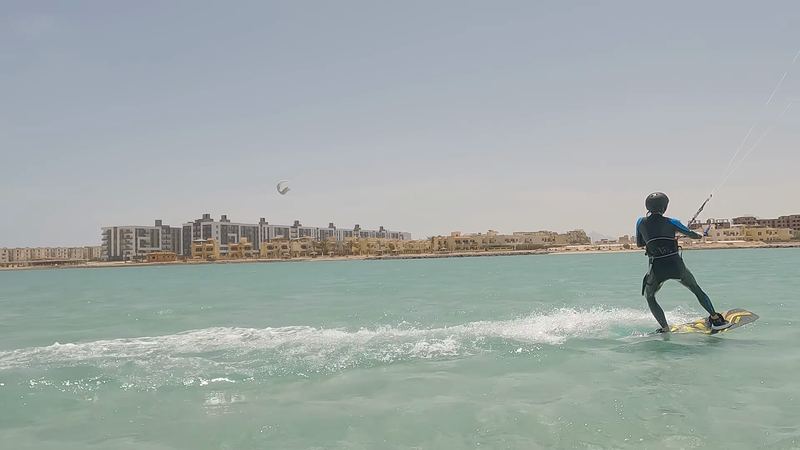
Kitesurfing definition: what it is and how it differs from kiteboarding
Kitesurfing means riding a board on water while a kite on long lines pulls you along. Kiteboarding is the same sport under another name, and kiting covers snow and land too.
A plain kitesurfing definition is riding a board on water while a kite on lines about 22 metres long pulls you along. You steer the kite with a bar in your hands, and the pull goes through a harness around your hips. Kiteboarding is the same sport under a different name. Kiting is the wider word and also covers snowkiting and landkiting.
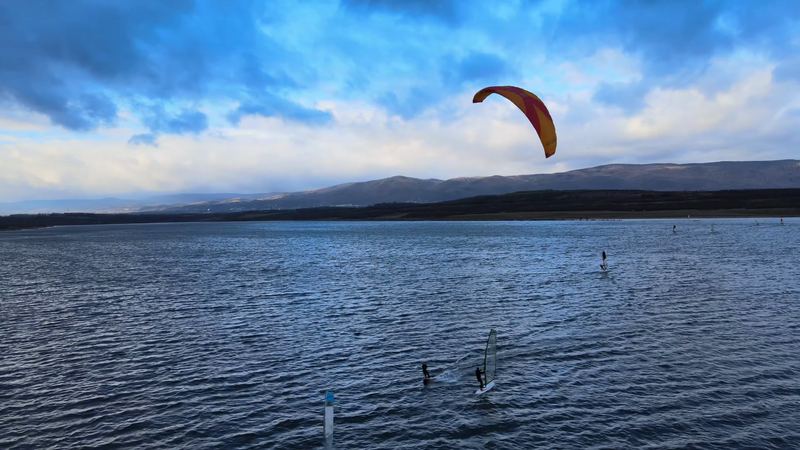
I ride all three: on water at Lake Milada in the Czech Republic and by the sea, on snow in the Ore Mountains in winter, and on land in a buggy. The simplest explanation I know: the kite pulls, you push against it with the edge of your board, and the ride comes out of those two forces.
If you're only thinking about trying it: you can learn it, but with an instructor, and not in one afternoon. You'll spend the first days more in the water than on the board, and that's normal.
Kitesurfing vs kiteboarding
On water, both words mean riding a board behind a kite. Which one you hear depends mostly on the country. In the UK people tend to say kitesurfing, in the USA kiteboarding. In the UK, though, kiteboarding can also mean riding a board with big wheels along the beach. At the Olympic Games, kiteboarding made its debut at Paris 2024, with separate men's and women's events.
Most riders just say kiting: "going kiting", "a good kiting day". On the beach you'll hear kite and board everywhere.
How kitesurfing works
The kite you ride on water is a fabric wing with an inflated tube along the front edge and a few smaller tubes running across. When it drops, it floats and you send it back up. Its lines run to the bar, which you hold with both hands. Pulling the bar in and letting it out changes how hard the kite pulls, and tilting it steers left and right.
A lot depends on where the kite sits in the sky:
- Straight overhead, "at 12 o'clock", it pulls little, and mostly upwards. In gusty wind, though, it can stall and drop forward into the power zone, and the next gust yanks you downwind. So you only pass through 12 when you move the kite from one side to the other. When you stand, keep it lower, at about 45 degrees.
- Lower in front of you and off to the side is the power zone. The more you move the kite through it, the harder it pulls.
- At the edge, to your left or right, it pulls least. This is where kites are launched and landed.
You don't hold the pull with your arms. You hook the loop under the bar into a harness, a wide belt around your waist or under your bum, and your hips take the load. Your hands only steer. To actually ride instead of being dragged along, you dig the edge of the board in against the pull. Riders know it as edging, and most of your first sessions are about finding the balance between the kite and that edge.
The quick release comes first
The bar has a safety release, the quick release. Push it away from you and the kite loses its power, while you stay attached only by the leash, so the kite doesn't fly off. When a strong gust hits or your lines tangle, there's no time to think about where it is. That's why a good instructor has you practise it right at the start, on land, and then again in the water.
What gear you need
You don't need to buy anything for a course, the school usually includes or rents the gear. It helps to know what you'll be handed, though:
- A kite, sized for the wind strength and your weight. Sizes are given in square metres.
- A bar with lines and a quick release.
- A harness to hook the bar's loop into.
- A board, usually a twintip to start with: a symmetrical board you ride in both directions without turning it around.
- A wetsuit or lycra, depending on the water temperature. A helmet and a buoyancy vest are a good idea on a course too.
What to buy once you ride on your own is covered in my guide to kitesurfing gear for beginners.
Types of kiting
Your kite and bar are much the same everywhere. What changes is what you stand or sit on, and what's underneath: water, snow or a meadow.
| Discipline | What you ride | What it's about |
|---|---|---|
| Freeride | twintip | riding around for fun, where everyone starts |
| Freestyle and big air | twintip | tricks and jumps |
| Waves | surfboard (directional) | riding waves at sea |
| Hydrofoil | board with a wing under the water | the board lifts out of the water and works in light wind |
| Snowkiting | skis or a snowboard | riding on snow, usually in the mountains |
| Landkiting | buggy or mountainboard | riding on land: fields, plains, beaches |
The Olympic Formula Kite class races on hydrofoils. That's not a first step for a beginner, though: most people only pick up the foil once they ride a twintip on their own.
Snowkiting
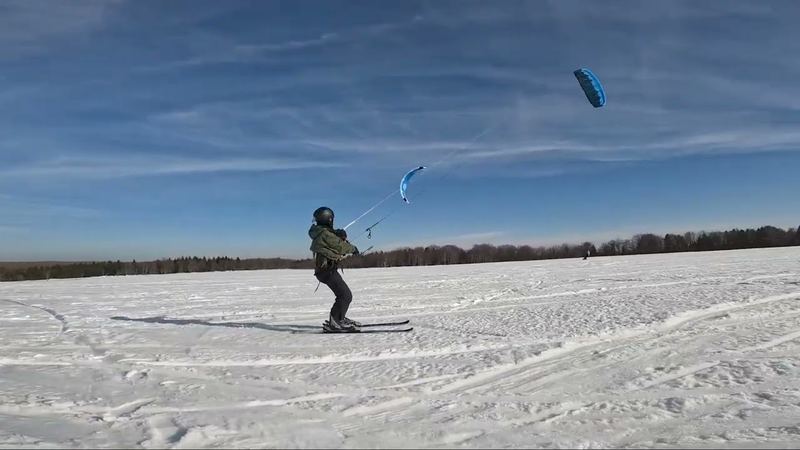
Snowkiting is a kite plus skis or a snowboard. In winter I ride at Moldava and Nakléřov in the Ore Mountains on a Kitech FreeRS 12 m. Up there small things decide the session: when the wind comes from the forest and you're close to the trees, the kite gets turbulent and unpleasant. Then you need to move a bit further away from them.
Landkiting
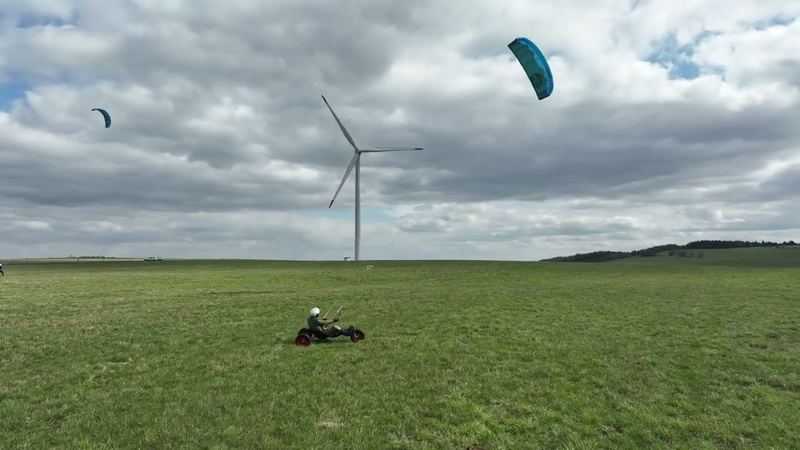
Landkiting means riding on land: in a buggy, a low three-wheeler you sit in, or on a mountainboard, a board with wheels. I ride my buggy near Fojtovice in the Ore Mountains, and in December 2023 I raced the Czech landkiting championship in Panenský Týnec. I still have a lot to learn on wheels.
Kitesurfing vs wing foiling vs windsurfing
The difference is how you're connected to the thing that pulls you. In kitesurfing the kite flies on lines far away from you and you only hold the bar. In wing foiling you hold an inflatable wing directly in your hands, with no lines, and ride a hydrofoil board. In windsurfing the sail and mast are attached to the board by a joint, and you hold the sail by the boom.
A kite needs more space to launch and land, and you have over 20 metres of lines around you to keep in mind. If you're torn between kite and wing, have a look at kitesurfing or wing foiling first.
How you learn to kitesurf
Learning follows a clear order, and each step builds on the one before:
- A trainer kite on land. A small kite without a board, where you learn where the power zone is and how the kite reacts. More in the guide to trainer kites.
- Flying the kite by the water, plus the quick release for real.
- Body drag. The kite pulls you through the water without a board. Among other things, this is how you get back to a board you've lost.
- Waterstart. You get onto the board in the water and the kite pulls you up.
- First rides in both directions.
- Upwind, riding against the wind. Until you can do it, the wind slowly pushes you down the beach and you walk back to where you started.
Self rescue belongs here too: when you can't ride back, you let go with the quick release, work your way along the lines to the kite and swim with it to shore. And the wind direction: beginners learn when the wind blows along the shore or at an angle onto it. Straight onshore wind is harder, because it pushes you onto the beach. Never in offshore wind, which blows from the beach out to sea.
I don't like crash courses that get you riding without knowing why or where you're allowed to go. A good course teaches you to read the wind and the spot and to handle a situation that goes wrong, so you're not a danger to yourself or others when you turn up at a new spot. What to ask before you pay for one is in how to choose a kite school. The whole path from the first lesson to riding on your own is in how to learn kitesurfing.
How fast it goes
In April 2024 we took 8 beginners with us on a kite safari in the Red Sea and spent the first two days at Geisum island. The first day looked tough, by the middle of the second day everyone was riding. Don't take that as a promise it'll go the same for you: it depends on the wind, the instructor and what you bring with you.
On the kite safari in Egypt you can add a 6-day beginner course for €600 including gear (2026 prices). Beginners are welcome, as long as they know what they're signing up for: the safari gives the most to people who already ride on their own.
Is kitesurfing dangerous or hard?
A kite is strong, and in wind you're not ready for yet it can throw you around properly. That's why you start with a small kite, with an instructor and in conditions that match your level. That way you can learn kiting as an adult too, without much of a sporting background.
What's hard at first is keeping an eye on several things at once: the kite, the board, your direction, other riders. That feeling of doing 15 things at the same time, and forgetting one the moment you focus on another, I still know from jumping. With every hour on the water, more of it happens by itself. More on the risks and what's manageable in is kitesurfing hard and is it dangerous.
Questions
What is the definition of kitesurfing?
Kitesurfing is a water sport where you ride a board while a large kite on lines about 22 m long pulls you. You steer the kite with a bar in your hands and the pull goes through a harness around your hips. Kiting is the wider word that also covers snowkiting and landkiting.
What is the difference between kitesurfing and kiteboarding?
On water it's the same sport. Kitesurfing is the more common word in the UK, kiteboarding in the USA, and in the UK kiteboarding can also mean riding a wheeled board on the beach.
Is kiteboarding an Olympic sport?
Yes. Men's and women's kiteboarding made its Olympic debut at Paris 2024, raced in the Formula Kite class on hydrofoil boards.
How far away from the rider does the kite fly?
A standard bar comes with 22 m lines, so the kite flies more than 20 m away from you.
Can you learn kitesurfing without lessons?
I wouldn't. A kite is powerful, and a course teaches you more than riding: reading the wind, using the quick release and getting yourself out of trouble.
Sources
- The UK term for riding a board on water behind a kite is kitesurfing, the US term is kiteboarding; in the UK kiteboarding also means the dry version on a wheeled board on sand thekitesurfcentre.com (checked 17 October 2026)
- A kite kept at 12 in gusty wind is more likely to frontstall and drop into the power zone; 12 only when moving the kite through the window, otherwise keep it at 45 degrees d8.ikointl.com (checked 17 October 2026)
- In windsurfing the rig is connected to the board by a universal joint and the sailor holds the sail via a wishbone boom en.wikipedia.org (checked 17 October 2026)
- The IOC Executive Board approved Men's and Women's Kiteboarding (Formula Kite) for the Paris 2024 Olympic Sailing Competition on 10 June 2021 sailing.org (checked 17 October 2026)
- Formula Kite is a hydrofoiling kite-racing class with a foil kite and a board with a hydrofoil www.sailing.org (checked 17 October 2026)
- A standard all-round bar comes with 22 m lines and a 2 m extension set to 24 m www.duotonesports.com (checked 17 October 2026)
- 22 m flying lines; the quick release is a push-away release, leash compliant with ISO 21853:2020 northactionsports.com (checked 17 October 2026)
- Beginner course on the kite safari: 600 EUR, 6-day intensive course including kite equipment (2026 price list) paradisekitesurf.cz (checked 17 October 2026)