Gusty kitesurfing and turbulence: when to stay ashore
I wouldn't go out if I couldn't control the kite in the gusts, the launch was in turbulent wind behind an obstacle, or a storm was coming. Offshore wind requires active rescue cover arranged in advance; I'd avoid it for your first independent sessions.
You feel gusty wind the moment you're out. The kite pulls evenly for a while, then a gust yanks you off the water, and a few seconds later the kite drops. With gusty kitesurfing, I'd stay ashore if I couldn't control the kite in the gusts, the launch was in turbulent wind behind trees, buildings or a hill, the wind was offshore without active rescue cover arranged in advance, or a storm was coming.
If you've only had a handful of independent sessions, start in mild conditions at a spot you know. Being nervous about gusts is normal, and it's a healthy instinct. Even experienced riders need to handle the full wind range on their chosen kite, with room between them, the beach and obstacles. A smaller kite alone won't fix conditions where you lose control or the wind could change sharply.
What the gust number in a forecast means
A forecast gives you 2 numbers: wind and gusts. Wind is the average, usually over 10 minutes in Windy. Gusts are the highest speed the wind briefly jumps to, and you don't add them to the average. If Windy shows 15 knots gusting 25, the gust hits at 25 knots.
Look at the full range: how strong the gusts are and how far the wind drops between them. The average isn't the minimum, and the gap between average and gusts alone won't tell you whether to ride. 15-20 knots with the odd gust to 25 is a very different session from 15-20 knots gusting 30. If your forecast is in metres per second, 10 knots is roughly 5 m/s.
A gust usually lasts less than 20 seconds. There's no time to work out a plan while it's happening, so the reaction has to be one you've already practised. When reading a wind forecast, check the direction and changes through the day, then compare it with what's happening at the spot.
Where turbulence comes from
The most common cause of choppy, gusty wind is an obstacle the air has to cross before it reaches you. Behind trees, houses or a hill the airflow breaks up, and instead of a steady pull you get lulls and gusts taking turns. Trees and buildings create rougher turbulence than sand dunes.
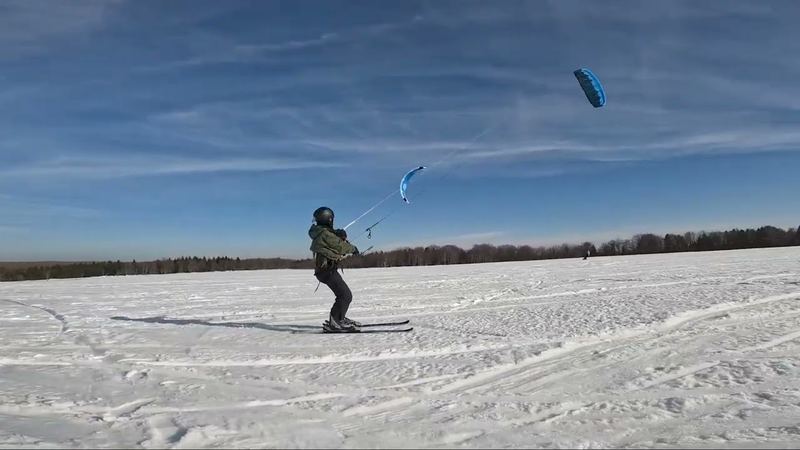
I know this from snowkiting at Moldava in the Czech Ore Mountains. Up on the plateau, when the wind blows from the forest and I'm close to the trees, the kite behaves turbulently and it's unpleasant. The fix is to ride a bit further away.
Don't choose your launch just by its distance from the trees. A rough estimate for turbulence downwind is 7 times the obstacle's height: 140 m for a 20 m obstacle. Gusts can still be felt further away. Behind windbreaks, reduced wind speeds can be measured up to 30 times their height, or 600 m in this example. These figures illustrate how far an obstacle can affect the wind; they aren't safe kiting boundaries. Wind speed and direction, obstacle shape and density all matter. Assess the launch with someone who knows the spot, and don't launch there if it's turbulent. Right in front of a building or fence the airflow is disturbed too, deflecting and compressing against it.
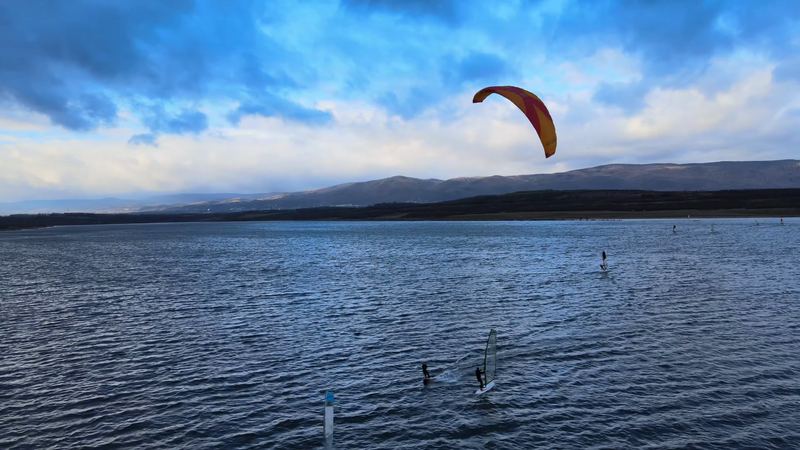
There's a broader rule as well: the more land, fields, villages and forest the wind has crossed, the more gusts it picks up. Inland lakes and fields almost always get wind that has travelled over land, so expect gusts more often there than on a coast where the wind comes off the sea.
Offshore wind
Wind blowing from the beach out to the water (offshore) is a trap. It comes over land, so it tends to be unstable, and if something goes wrong it carries you away from the shore into open water. Avoid it for your first independent sessions. Even an experienced rider needs active rescue cover arranged in advance: a boat already on the water, a pilot trained for deep-water rescue and someone ashore who knows you're riding and watches you.
When assessing wind direction, distinguish side-onshore, blowing diagonally towards the beach, from direct onshore. For your first independent sessions, I'd look for a suitable side-onshore spot with clear space and help arranged for launching and landing. Direct onshore requires you to ride upwind away from the beach immediately; a mistake can send you back onto the shore. Direction alone isn't enough: assess local currents, obstacles and space with someone who knows the spot.
Storms and fronts: the gusts you can't forecast
Gusts caused by obstacles are fairly predictable. You know the spot and which directions blow clean and which blow messy. Gusts from a front or a rain shower are very hard to predict in advance.
A thunderstorm pushes strong wind out ahead of itself. Forecasters name the leading edge a gust front, and it sometimes comes with a low shelf cloud. When you see a dark wall of cloud approaching, land and pack up straight away. Waiting until it arrives is too late. If you're still on the water, don't park the kite overhead: a strong gust can loft you from 12 o'clock.
For the worst case, your quick release, the handle that releases the bar from your harness, has to be second nature, so your hand finds it without looking. Using it is a basic kitesurfing safety skill to master before riding independently.
When to go and when to stay on the beach
| Situation | You've had a few solo sessions | You ride confidently |
|---|---|---|
| Mild gusts, side-onshore wind | consider riding only after assessing the spot, full wind range and gear; arrange help launching and landing | assess the full wind range, gear and room for error |
| Gusts exceed your kite control, or the wind could change sharply | stay on the beach | stay on the beach; a smaller kite alone isn't enough |
| Direct onshore wind | don't ride independently unless you can ride upwind reliably | assess your ability to get away from shore and room for mistakes |
| Wind reaching the launch over trees, houses or a hill | stay on the beach, or find a spot well away from the obstacle | launch well away from it and stay out of its wind shadow |
| Offshore wind | stay on the beach | only in manageable conditions with rescue arranged: boat on the water, trained pilot and someone watching from shore |
| A storm or dark wall of cloud coming | stay on the beach | stay on the beach |
| You can't tell how gusty it is | ask riders who are already out and watch for a while | ask riders who are already out |
When a gust catches you on the water
Ride slower through a gust. Push the bar out, shift your weight onto your heels, edge harder and point further upwind. The board digs in and acts as a brake. If you let the gust speed you up, the board rises, there's less drag, you speed up more, and it ends in a crash.
In strong gusty wind, don't leave the kite at 12. Keep it lower, around 10 or 2 o'clock. If your edging and speed control aren't solid yet, you'll need the kite a little higher, because a low kite pulls you sideways too hard. That's also why a beginner needs a smaller kite in gusty wind than an experienced rider.
If the wind drops slightly and you're still riding, try to keep your speed. You can sheet in and turn the board's nose more towards the kite. In a deeper lull, work the kite, but don't choke it by holding the bar in. If it starts flying backwards and dropping trailing edge first (backstall), ease the bar out. When there isn't enough wind to ride but you can still keep the kite flying, focus on it and weave it slowly back and forth.
In light, gusty wind the kite drops most often when you stop: while putting the board on, while body dragging, during a transition. Don't wait with the kite at 12. Put the board on with the kite lower and start riding straight away. Once you're moving, the kite sees steadier wind and drops far less often.
Kite size for gusty days
On a gusty day, size for the stronger end of the range, closer to the gusts. With a smaller kite you'll sit through a lull for a moment, keep the kite flying and wait. With a big kite, a gust near the beach can drag you up onto the sand.
For working out size from your weight and the wind, see what size kite do I need. On a gusty day, enter a wind speed closer to the gusts in the kite size calculator.
Where to learn riding in gusts
You can get used to gusts gradually. Start on a mildly gusty day when you can handle the full wind range with your gear, and leave plenty of space around you. Set up further from hazards and closer to the water, so you've got room for a mistake.
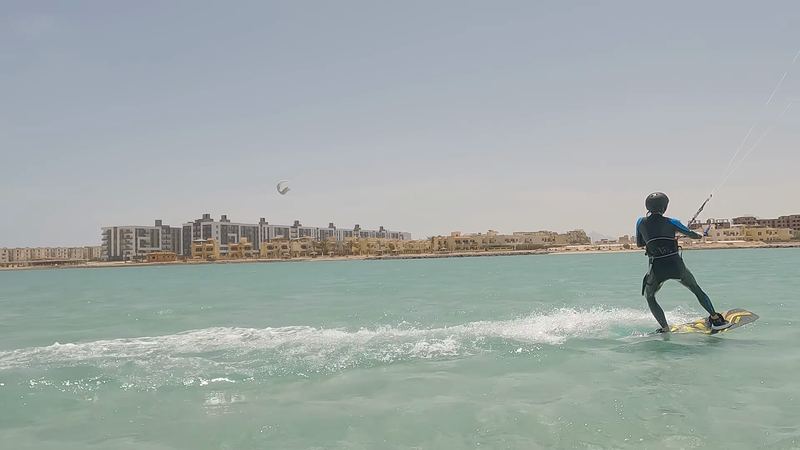
On the kite safari in Egypt I rode around islands where there's nothing, just sand, and the wind blows all the time. The organiser lists a steady 15-25 knots at Tawila. The main kite days have morning and afternoon riding, with evening video coaching scheduled on days 3-6 so you can see your own riding. The crew helps with launching and landing and provides boat rescue. They choose spots for the wind, and riding follows the conditions.
The crew also organises downwinders, longer rides with the wind between islands.
Questions
How gusty is too gusty for kitesurfing?
The gap between average wind and gusts alone cannot tell you whether it's safe: the full wind range, your gear, skills and spot all matter. Stay ashore if you cannot control the kite in the gusts or conditions could change sharply. For your first independent sessions, look for a suitable side-onshore spot with plenty of space and help launching and landing.
What does the gust number in a wind forecast mean?
The wind figure is an average, usually over 10 minutes, and the gust figure is the short peak. They don't add up: 15 knots gusting 25 means 25 knots in the gust, not 40.
How far from trees or buildings should I kite?
A multiple of the obstacle's height cannot give you a safe kiting distance. The reach of turbulence also depends on wind speed and direction, and the obstacle's shape and density. Assess the launch with someone who knows the spot; don't launch there if it's in turbulent wind.
What size kite should I use in gusty wind?
Size for the stronger end of the range, closer to the gusts. Beginners need a smaller kite in gusty wind than experienced riders, because their edging and speed control aren't there yet.
What should I do if a storm is coming while I'm kiting?
Land and pack up as soon as you see a dark wall of cloud approaching. The gusty outflow from a thunderstorm arrives ahead of the storm itself, so waiting until it's overhead is too late.
Sources
- In Windy, wind is the average speed, generally over 10 minutes, and gusts are the maximum speed; gusts are not added to the average (15 km/h gusting 20 km/h means 20 km/h at most) community.windy.com (checked 17 October 2026)
- NWS: a gust is a rapid fluctuation of wind speed with variations of 10 knots or more between peaks and lulls forecast.weather.gov (checked 17 October 2026)
- 1 knot = 0.5144 m/s www.nist.gov (checked 17 October 2026)
- 15-20 knots with the odd gust to 25 is more manageable than 15-20 knots gusting 30; gusts generally last less than 20 seconds; pick the kite for the gusts rather than the minimum www.mackiteboarding.com (checked 17 October 2026)
- Wind speed reductions can be measured up to 30 times a windbreak's height downwind and 2-5 times upwind; effects depend on height, density, shape and orientation, and these are not safe kiting distances nfs.unl.edu (checked 17 October 2026)
- The estimate of 7 times an obstacle's height downwind is not a fixed boundary: gusts can extend further depending on wind speed and obstacle shape; trees and houses cause stronger turbulence than dunes; launching just upwind of an obstacle is risky; side-onshore is preferable, direct onshore requires riding upwind immediately; offshore carries riders away and tends to be unstable; the video illustrates wind acceleration between Naxos and Paros www.youtube.com (checked 17 October 2026)
- Ride slower through a gust (bar out, weight to the heels, further upwind); in strong gusty wind keep the kite near 10 or 2 o'clock rather than 12 to avoid getting lofted; novices need a smaller kite in gusty conditions; sheet in only for a slight lull (7:42), work the kite in deeper lulls and focus on keeping it flying when there is too little wind to ride; in light gusty wind kites stall mostly when the rider sits still; wind passing over more land and obstacles picks up more gusts; frontal and rain gusts are very hard to predict; start in mildly gusty conditions, ask riders already out, set up further from hazards and nearer the water www.youtube.com (checked 17 October 2026)
- NWS: a gust front is the leading edge of gusty surface winds from thunderstorm downdrafts, sometimes associated with a shelf cloud or roll cloud forecast.weather.gov (checked 17 October 2026)
- Safari: morning and afternoon kiting on days 2-6, evening video coaching on days 3-6, final session on day 7; spots chosen for conditions, organised downwinders, rescue boat and launch and landing assistance; Tawila steady wind 15-25 knots paradisekitesurf.cz (checked 17 October 2026)
- Duotone EVO 2026, section 2.6: do not ride in wind too strong for precise kite control or when conditions may change dramatically; assess forecasts and local conditions, avoid offshore and be careful with onshore wind a.storyblok.com (checked 17 October 2026)
- IKO: offshore riding requires a boat already on the water with a pilot trained for deep-water rescue and someone ashore aware that you are kiting d8.ikointl.com (checked 17 October 2026)
- FLYSURFER INDIE, Emergencies: recover a backstalling kite flying backwards by depowering, pushing the bar away flysurfer.com (checked 17 October 2026)
- IKO includes assisted launching and landing in its basic training www.ikointl.com (checked 17 October 2026)
- IKO recommends assisted landing; during normal sessions people ashore should be willing to help you land d8.ikointl.com (checked 17 October 2026)